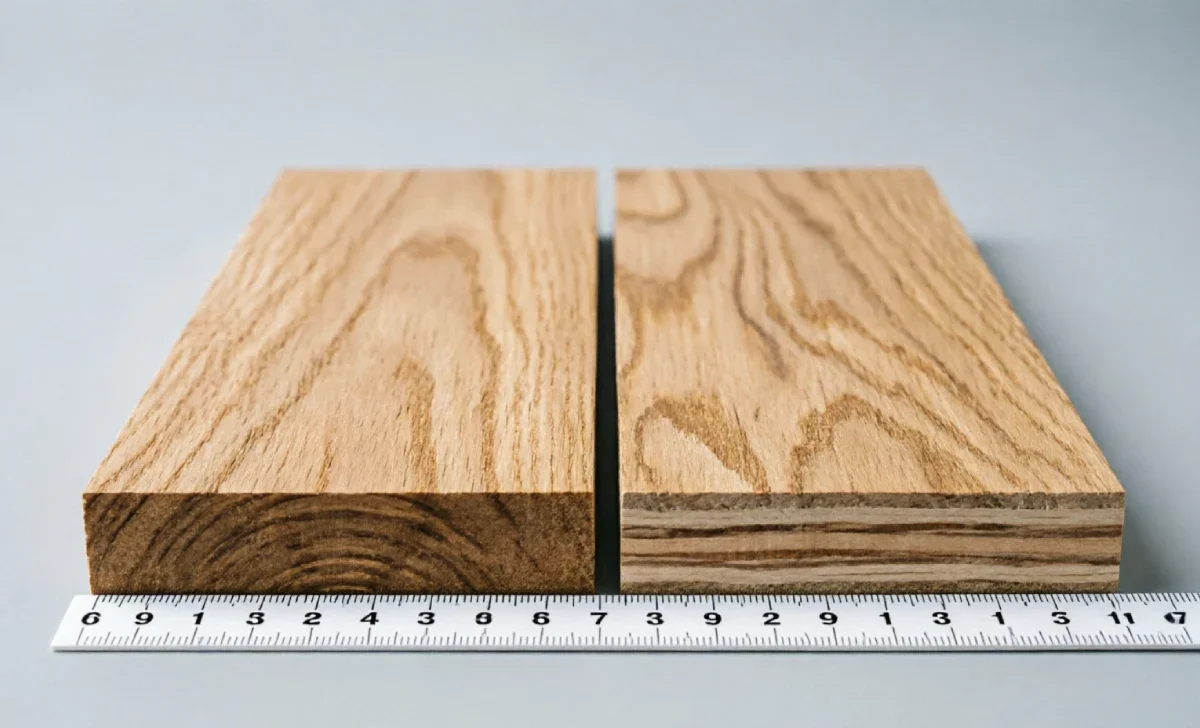
You want the warmth and character of real wood floors, but you’re caught between classic solid hardwood and modern engineered wood. Both are authentic wood, yet they behave very differently once installed. Pick the wrong one for your home, and you could face warping, costly rip-outs, or a floor that can’t be refinished when it starts to show its age.
This guide gives you a direct, undiluted comparison with current pricing, honest refinishing facts, and a room-by-room cheat sheet so you can choose with total confidence.
What Is Solid Hardwood Flooring?
Solid hardwood is exactly what it sounds like: a single, solid piece of wood milled from a timber plank. In the UK and US, it typically comes as a 3/4-inch (19mm) thick tongue-and-groove board that is nailed or stapled to a wooden subfloor. Because it’s one species all the way through, solid hardwood can be sanded and refinished multiple times—usually four or five over a lifespan that easily exceeds 100 years. The natural grain and colour deepen with age, giving it an irreplaceable patina.
What Is Engineered Wood Flooring?
Engineered wood is real wood, not laminate. It’s built from a top layer (wear layer) of genuine hardwood bonded to a cross-layered plywood or high-density fibreboard (HDF) core. That criss-cross construction makes the plank far more dimensionally stable than solid wood. You still get the same oak, walnut or hickory surface underfoot, but the floor won’t swell and shrink as dramatically when humidity changes.
The critical variable is the wear layer thickness. Budget products may have a rotary-peeled veneer just 0.6mm thick, while premium engineered boards feature a sawn-cut wear layer of 3mm to 6mm—which can actually be sanded and refinished like solid wood. Always check this specification before buying.
When preparing any subfloor for a wood installation, it’s vital to use correct moisture treatments. Applying the wrong product can trap moisture and ruin the floor. For example, we’ve detailed why Kilz is not recommended for flooring and what to use instead to protect your investment.
Core Differences at a Glance
| Factor | Solid Hardwood | Engineered Wood |
|---|---|---|
| Composition | One solid piece of timber | Real wood veneer on plywood/HDF core |
| Thickness | Usually ¾ inch (19mm) | ⅜–¾ inch (10–19mm) |
| Installation | Nail-down only, on wood subfloor | Float, glue-down, or nail-down |
| Refinishing | 4–5 times over its life | 0–2 times, depending on wear layer |
| Moisture resistance | Poor; not for basements | Good; stable in moderate humidity |
| Radiant heat | Not recommended | Yes, with floating or glue-down method |
| Typical material cost (2026) | £40–£100/m² | £25–£85/m² |
| Lifespan | 100+ years | 20–80+ years |
Cost & Installation: What You’ll Really Pay in 2026
Budget is often the first concern. Solid hardwood materials cost about £40–£100 per square metre, while engineered wood ranges from £25 to £85/m². However, high-end engineered boards with thick sawn wear layers frequently equal or exceed mid-grade solid wood prices. Labour tells a similar story. Nail-down solid hardwood installation runs £25–£50/m², whereas floating an engineered floor can cost £15–£35/m².
The real cost difference often lies in subfloor preparation. Solid wood demands a timber subfloor and is unsuitable over concrete. Engineered wood can be floated over concrete with a proper underlayment, making it the go-to choice for flats, newer homes, and renovations where you don’t want to raise the floor height. If you’re considering a fully waterproof alternative that looks like wood but can handle wet areas, you might explore options like Nucore flooring, which is a luxury vinyl plank rather than real wood but works well in bathrooms and basements.
Durability, Refinishing & Real-World Lifespan
Solid hardwood wins on pure longevity. Because you can sand it down by about 1mm each time, a 19mm plank can handle four or five full refinishes. Even a badly scratched 50-year-old oak floor can be made to look brand new.
Engineered wood’s refinishing potential depends entirely on its wear layer. A 2mm veneer can usually tolerate one light sanding by a professional. A 3mm–6mm sawn wear layer can be refinished twice. Many engineered floors sold today have a 2mm layer, so treat them as “one refresh” floors. The good news is that modern factory finishes (aluminium oxide or UV-cured polyurethane) are extremely scratch-resistant, so you may only need a light screen and recoat after 10–15 years, which doesn’t touch the wood itself.
Moisture, Humidity & Where You Can Install
Hardwood expands and contracts significantly across its width with seasonal humidity changes. If installed in a damp basement or over a poorly prepared concrete slab, it will cup, crown, or buckle. Engineered wood’s plywood core resists this movement, making it the clear winner for kitchens, utility rooms, and below-grade spaces. Still, no wood floor is waterproof. Standing water will damage any real wood product. Engineered boards offer a wider safety margin, but they are not a substitute for tile or luxury vinyl in a full bathroom.
Health & Indoor Air Quality
All composite wood products can emit trace formaldehyde from the adhesives used in their cores. To protect your family, only choose engineered flooring that is CARB Phase 2 or TSCA Title VI compliant, and look for FloorScore or GREENGUARD Gold certifications. These products are independently tested and safe for indoor air quality. Solid hardwood, being a single piece of lumber, has no added adhesives and is inherently low-VOC, but factory prefinished coatings should still be checked for low emissions.
Which Floor Is Right for Your Room?
- Living room, bedroom, hallway (timber subfloor): Solid hardwood, if you want a forever floor and plan to stay long-term.
- Kitchen, utility, basement, flat: Engineered wood, preferably with a thick wear layer and a click-lock floating installation.
- Over underfloor heating: Engineered wood only, and check the manufacturer’s maximum heat rating (usually 27°C).
- Heavy pets and kids: Choose a hard species like brushed or matte-finished hickory or maple in an engineered plank; the textured surface hides scratches.
What to Look for When Buying
- Wear layer thickness: 2mm minimum for any light sanding; 3mm+ for long-term peace of mind.
- Core quality: Multi-ply Baltic birch is the gold standard. Avoid thin, low-density HDF cores that can swell.
- Certifications: FloorScore or GREENGUARD Gold for air quality; FSC for responsible forestry.
- Finish warranty: A 25-year residential finish warranty signals a durable factory coating.
- Return policy: Always view a full-box sample in your own lighting before committing.
A Quick Cleaning Note
Once your new floor is down, keeping it beautiful is straightforward but requires the right approach. Never use a steam mop—the heat and moisture will delaminate engineered planks and cup solid boards. Instead, follow a simple routine. You’ll find a complete hardwood floor cleaning guide that explains the safe way to clean real wood floors without damaging the finish.
Final Verdict
There is no universally superior floor. Solid hardwood is the heirloom choice: it lasts a lifetime, can be fully restored, and adds undeniable charm. Engineered wood is the modern solution for tricky subfloors, underfloor heating, and busy households that need stability without sacrificing the look of real timber. For many of today’s homeowners, a high-quality engineered board with a 3mm+ wear layer gives the best balance of beauty, budget, and real-world performance.
Buy from a reputable supplier, never compromise on the wear layer, and take your time with samples. The right wood floor will outlast your furniture and welcome you home every day for decades.