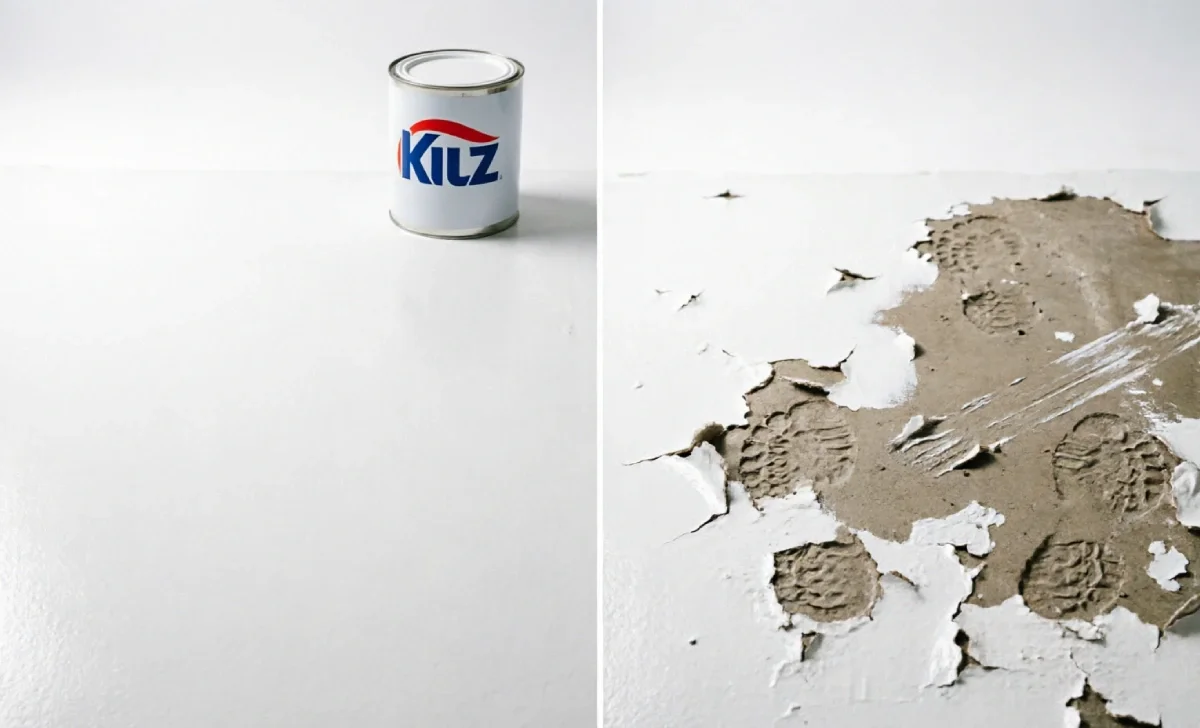
If you're planning a flooring project and considering Kilz primer, you need to understand why Kilz is not recommended for flooring before you start. Right there on the can, in clear black lettering, it states: "Not recommended for floors." Yet thousands of DIYers ignore this warning every year, only to watch their primer peel, wear off, or fail within months. The frustration is real, the wasted money is significant, and the lesson is harsh but simple—Kilz simply isn't designed for the demands that floors place on any coating. If you're exploring different flooring options for your home, check out these best home flooring options to make an informed decision.
This isn't just my opinion or some random internet advice. It's the official stance from the manufacturer themselves. Kilz Original, one of their most popular products, explicitly warns against floor use. Kilz Restoration, their heavy-duty stain and odor blocker, states it's "not suitable as a primer for floor coatings." Even Kilz 2, the water-based all-purpose version, isn't recommended for flooring applications by the company that makes it. The only exception they allow is using Kilz Restoration to block odors from subfloors when replacing carpet or wood flooring—but even then, it must be covered with proper flooring, never left as a finished surface.
6 Critical Reasons Kilz Fails on Floors
Reason #1: Cannot Handle Foot Traffic
So why does Kilz fail so spectacularly on floors? The reasons are technical, practical, and completely avoidable if you choose the right product from the start. The first and most critical reason is that Kilz cannot handle foot traffic. Think about what floors endure every single day. People walking back and forth, furniture being dragged across surfaces, pets running and scratching, dropped items, spills, and constant friction. Walls and ceilings, where Kilz is designed to be used, experience none of this. They're vertical surfaces that just sit there, protected from mechanical stress. Floors, on the other hand, are horizontal workhorses that take a beating 24/7.
Water-based Kilz products are particularly vulnerable to this abuse. They begin to wear, fade, and peel with regular use, often showing visible damage within weeks in high-traffic areas. Even oil-based Kilz, while initially more durable than its water-based counterpart, wasn't formulated to withstand the mechanical stress that floors face daily. The chemistry that makes Kilz excellent at blocking stains and sealing odors on walls simply doesn't translate to the durability needed for flooring. Users consistently report wear patterns appearing in doorways, hallways, and other high-traffic zones while the rest of the floor might still look acceptable—creating an uneven, patchy appearance that's both ugly and unsafe.
Reason #2: Poor Adhesion on Horizontal Surfaces
The second major problem is poor adhesion on horizontal surfaces. Kilz products are engineered for vertical applications, and their adhesive characteristics work beautifully on walls and ceilings. But when you apply them to floors, especially concrete, plywood, OSB, or previously painted surfaces, they often fail to create a strong, lasting bond. The same properties that help Kilz stick to vertical surfaces actually create problems when gravity isn't helping keep the coating in place. On floors, the primer can develop texture changes, poor bonding, and eventually lift, bubble, or flake off entirely. This is especially problematic in areas with temperature fluctuations, moisture exposure, or heavy loads.
Reason #3: It's a Primer, Not a Finish Coat
Here's something many people completely miss: Kilz is a primer, not a finish coat. It's designed to prepare surfaces for paint, to block stains, and to seal odors—not to serve as the final protective layer. When used on floors, Kilz lacks glossy or protective properties, creates a dull and unfinished appearance, offers no resistance to scuffs, stains, or moisture, and absolutely requires an additional topcoat to provide any real protection. And even if you do apply floor paint over Kilz, you're building on a weak foundation. The entire coating system is compromised from the start because the primer layer wasn't designed for floor use in the first place.
Reason #4: Moisture and Mold Vulnerability
Moisture and mold vulnerability is another critical issue, especially for basement floors, garage slabs, and bathrooms. Kilz Restoration's product specifications clearly state it's "not suitable for areas prone to mold and/or mildew." In moisture-prone environments, Kilz can absorb water vapor from concrete slabs, facilitate mold and mildew growth underneath the coating, blister and peel when exposed to hydrostatic pressure, and trap moisture that leads to rot in wood subfloors. Floor-specific primers include moisture barriers and vapor transmission controls that Kilz lacks entirely. Using Kilz in these environments is basically inviting moisture problems that can be expensive and unhealthy to fix later.
Reason #5: Strong Odor and VOC Concerns
Then there's the issue of strong odor and VOC concerns. Oil-based Kilz Original contains petroleum distillates and has a volatile organic compound content of 443 grams per liter. This creates a very strong odor that lingers for days or weeks, requires extensive ventilation during application and drying, and can cause dizziness, headaches, and nausea. It carries a California Proposition 65 warning for cancer and reproductive harm, and it's simply not safe for occupied spaces without proper respiratory protection. While water-based Kilz 2 has lower VOCs, it still isn't suitable for floors, so you're stuck choosing between two unsuitable options.
Reason #6: Extended Drying and Curing Times
Extended drying and curing times create practical problems, too. Kilz may be dry to the touch in one hour, but full curing takes significantly longer. On floors, this means foot traffic too soon causes permanent damage, flooring installation timelines get delayed, water-based formulas may remain tacky without proper air circulation, and professional projects can't afford these kinds of delays. Floor-specific primers are formulated for faster cure times and can handle light traffic much sooner.
When Can You Actually Use Kilz on Floors?
Now, there are only two scenarios where Kilz has any legitimate floor-related use, and understanding these exceptions is important. First, Kilz Restoration can seal subfloors to block odors from pet urine, smoke damage, mildew, or old carpet adhesives. But here's the critical requirement: you must install proper flooring like carpet, vinyl, laminate, or engineered wood over the sealed subfloor. Kilz cannot be the finished surface. If you're considering creative installations, you might find this guide on laminate flooring on walls ideas interesting for alternative applications. Second, Kilz can be applied to concrete subfloors, but only if it's followed by Kilz 1-Part Epoxy Concrete and Garage Floor Paint or a dedicated epoxy floor coating. Used alone, it provides no durability, no glossy finish, and no long-term protection.
Best Alternatives to Kilz for Flooring
So what should you use instead? For concrete floors, consider Kilz 1-Part Epoxy Acrylic Concrete and Garage Floor Paint, which is the manufacturer's own floor-specific solution that resists hot tire pickup, cracking, and peeling. Epoxy floor primers from brands like Rust-Oleum EpoxyShield provide superior penetration into concrete, create waterproof seals, and offer professional-grade protection lasting five to ten years. Sherwin-Williams Loxon Concrete Primer is a professional contractor's preference with superior porosity sealing.
For wood subfloors, Zinsser BIN pigmented shellac offers superior odor blocking for severe cases and faster drying than oil-based products. Dedicated floor primers like Henry Bond Enhancer for tile installation, Mapei Primer G for professional flooring, or Bona Prime for wood floor finishing are all engineered specifically for their intended applications. For basement and moisture-prone areas, always choose epoxy-based floor primers with vapor barrier properties, mold and mildew resistance, hydrostatic pressure ratings, and moisture transmission controls. If you're designing a kitchen and considering dark flooring options, make sure to use the right primer and coating system from the start.
What to Do If You Already Used Kilz
If you've already made the mistake of using Kilz on your floors, don't panic. You have three options. You can remove the Kilz completely through scraping, sanding, or chemical strippers, which is necessary if you see peeling, flaking, or poor adhesion, and is the safest approach for long-term results. You can apply a proper floor coating over the Kilz if it's well-bonded with no moisture issues, though this requires thorough surface preparation and compatibility testing. Or you can install flooring like carpet, vinyl, laminate, or engineered wood over the sealed subfloor if you used Kilz for odor blocking, making sure the Kilz is fully cured and following the flooring manufacturer's guidelines.
The Bottom Line
The bottom line is simple. Kilz primer products are excellent for their intended purposes—walls, ceilings, stain blocking, and odor sealing. But they're simply not engineered for the demands of flooring applications. The manufacturer's warnings are clear, the technical limitations are real, and the consequences of ignoring them are costly. Your flooring project deserves products designed specifically for floors: epoxy primers, concrete sealers, or dedicated floor coatings.
Invest in the right materials from the start, and your floors will look great and last for years. Cut corners with Kilz, and you'll be redoing the entire job within months, spending more money and time than if you'd just used the correct product initially. When it comes to flooring, using the right primer isn't just recommended—it's essential for a successful, long-lasting result.