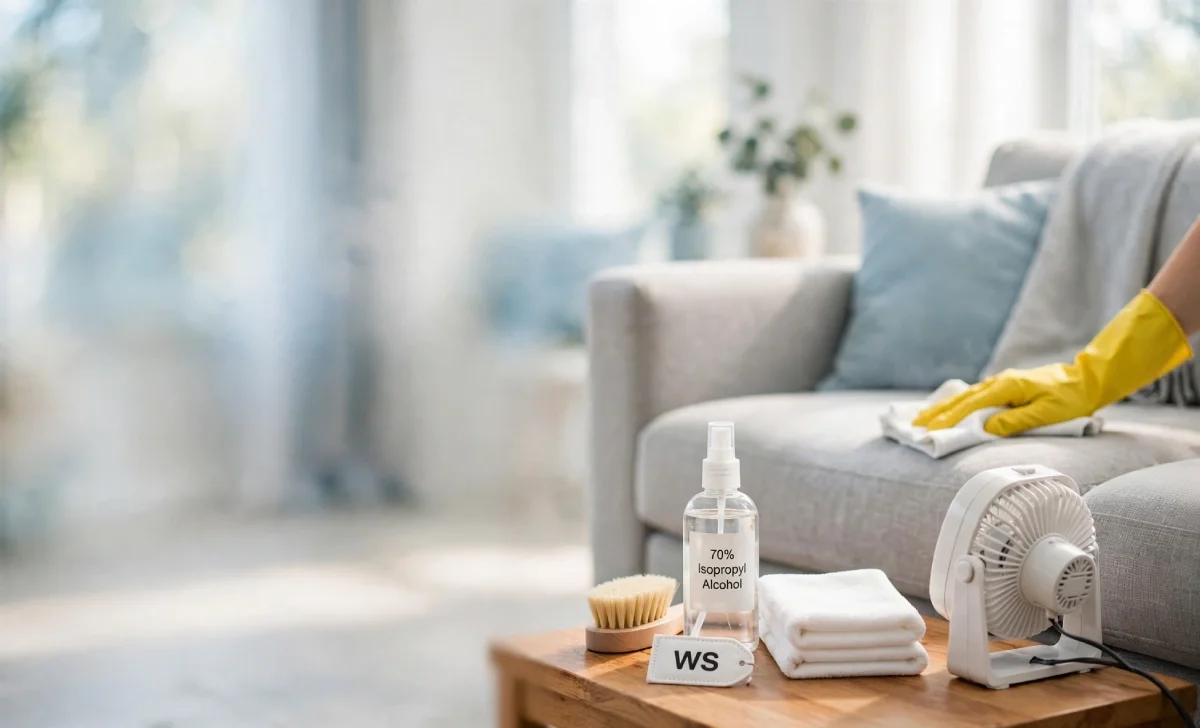
You do not need a steam cleaner to get a couch clean. For some fabrics, steam is the last thing you should use. The real risk is not the absence of steam — it is the wrong cleaner combined with too much moisture.
This guide gives you a code-first decision system: read the tag, match the method to your fabric, lift the dirt without soaking the foam, and dry it fast. Every recommendation here is built around manufacturer cleaning codes (W, S, WS, X, and DC) and a spot-test-first rule.
Short on time? Jump to the Quick Answer for the five-step sequence.
Quick Answer: The No-Steam Couch Cleaning Sequence
- Find the cleaning code on your sofa’s care tag (W, S, WS, X, or DC).
- Vacuum every surface, seam, and crevice with an upholstery attachment.
- Spot-test your cleaner on a hidden area and let it dry completely.
- Apply the code-matched method with minimal moisture — foam or solvent, never a soaking liquid.
- Blot with a clean white cloth, then dry fast with airflow, not heat.
That is the whole job in five lines. The rest of this guide explains how to do each step correctly for your specific fabric.
Why Clean Without Steam — and When Steam Is the Wrong Tool
Steam cleaning means heat plus moisture, forced into fabric and foam. That combination is fine for some durable W-code fabrics. For others, it is a reliable way to cause damage.
Fabric manufacturers are explicit about this. Greenhouse Fabrics, a major upholstery fabric supplier whose care codes follow the Joint Industry Fabric Standards Committee (AHFA) standards, states plainly: “Steam cleaning or hot water extraction is not recommended for most of our upholstery fabrics”. The same guidance appears across industry care pages: steam is either restricted or discouraged for solvent-only and vacuum-only fabrics.
The damage is not theoretical. It falls into three predictable failure modes.
Water rings. When water penetrates an S-code fabric, dissolved minerals and soils wick to the drying edge and deposit there. The result is a permanent tide mark that is often harder to remove than the original stain.
Shrinkage and distortion. Heat plus moisture relaxes and then tightens natural fibers. Linen, cotton, and some rayons can pucker, shrink, or lose their shape. Aggressive scrubbing accelerates the problem.
Mildew and odor. Foam cushion cores do not dry from the inside out. Moisture that soaks into the padding can linger for days, creating the conditions for mold and a musty smell that returns every time the room gets humid.
Steam also does nothing for dry soil. Vacuuming is the step that removes crumbs, pet hair, and loose grit before any liquid touches the fabric. Skip it, and you turn dust into mud.
The industry is moving in this direction anyway. Upholstery and carpet cleaning methods now include low-moisture encapsulation alongside hot-water extraction, and the broader market is shifting toward lower-water, faster-drying approaches. The no-steam method is not a compromise. It is a controlled, fabric-safe alternative.
Step 0: Read Your Cleaning Code Before Anything Else
The care tag is the single most important piece of information you have. It is usually under the seat cushions, on the deck of the sofa, or stapled to the frame. If the tag is missing, look up the manufacturer’s care instructions by model number before you clean anything.
The codes are established by the Joint Industry Fabric Standards Committee and used across the upholstery industry. Here is what each one means.
W Code — Water-Based Cleaning Allowed
W fabrics can handle water-based cleaners. Use mild dish soap and water applied as foam or with a barely damp cloth. Avoid solvents on W fabric, because they can strip color. Do not soak the fabric — the goal is to lift surface soil, not to wet the cushion core.
S Code — Solvent-Only (No Water)
S fabric must be cleaned with a water-free solvent. Water causes permanent rings or fiber damage. Rubbing alcohol (isopropyl alcohol) is the most accessible solvent for home use. Apply it to a cloth, never pour it directly onto the fabric, and ventilate the room.
A note on concentration: 70% isopropyl alcohol is effective at dissolving oily soils because the water content helps the alcohol penetrate. 91% contains less water, evaporates faster, and reduces the risk of water rings on S-code microfiber. Both work; choose based on whether you are fighting oil (70%) or trying to minimize moisture (91%). Test on a hidden spot either way.
WS Code — Either Method, Test First
WS fabric tolerates water-based or solvent-based cleaners. The flexibility is useful, but spot-testing still matters. The cover fabric, its backing, and the cushion filling can react differently to the same cleaner.
X Code — Vacuum Only (No Liquids at All)
X fabric should never see water, solvent, or a damp cloth. Cleaning is limited to vacuuming and light brushing with a non-metallic, stiff-bristle brush. Solvent on X fabric can dissolve a finish or cause discoloration. Baking soda is safe for odor on X fabric because it is a dry powder, but it must be vacuumed out completely.
DC Code — Dry Clean Only
DC fabric should be handled by professional dry cleaning only. Do not attempt a water-based or solvent DIY method. If you are unsure whether your fabric is DC, treat it as DC and call a professional before experimenting.
Quick-Reference Cleaning Code Table
| Code | Safe Cleaner | Tool | What to Avoid |
|---|---|---|---|
| W | Mild dish soap + water (as foam) | Soft cloth or sponge, barely damp | Solvents; soaking |
| S | 70% or 91% isopropyl alcohol; water-free solvent | Cloth (apply to cloth, not fabric) | Water, steam, any water-based product |
| WS | Water-based or solvent-based, tested first | Cloth or soft brush | Over-wetting; mixing cleaner types |
| X | None — dry methods only | Vacuum; non-metallic stiff brush; baking soda | Water, solvents, damp cloths |
| DC | Professional dry cleaning only | — | All DIY liquids |
What to Use Instead of a Steam Cleaner: Tool & Method Matrix
You do not need a machine to clean a couch well. You need mechanical action, the right chemistry, and moisture control. Here are the practical options, ranked from lowest to highest effort and cost.
Tool Substitution Table
| Tool | Best For | Fabric Codes | Approx. Cost | Effort Level |
|---|---|---|---|---|
| Vacuum + upholstery attachment | Every job; dry soil removal | All codes | $0 (owned) | Low |
| Soft-bristle brush | Loosening embedded soil and pet hair | All codes (gentle) | $5–$10 | Low |
| Microfiber cloths (white) | Blotting, solvent application, buffing | All codes | $5–$15 | Low |
| Spray bottle | Applying alcohol or vinegar mist | S, WS, W | $2–$5 | Low |
| Pot lid + microfiber cloth | Low-budget friction cleaning | W, WS (surface soil) | $0 (household) | Medium |
| Drill brush (medium yellow) | Agitation on durable fabrics | W, WS (not delicate pile) | $15–$25 | Medium |
| Wet/dry shop vac | Manual extraction on W/WS | W, WS | $60–$80 | Medium–high |
| Box fan | Fast drying, mildew prevention | All codes | $40–$60 (if not owned) | Low |
The Drill Brush: Mechanical Agitation Without Steam
A medium-bristle drill brush attached to a standard drill provides consistent agitation that saves your wrists and lifts embedded soil more evenly than hand-scrubbing. It costs $15–$25 and works well on durable W and WS fabrics. Avoid it on velvet, chenille, or any delicate pile — the bristles can distort the nap. Black bristle brushes are too stiff for most upholstery; yellow medium is the safe default.
The Pot-Lid Friction Method (Zero-Budget Option)
If you want to spend nothing, wrap a microfiber cloth around a pot lid and secure the edges with a rubber band. Mix two cups of warm water with one tablespoon of clear dish soap. Dip the cloth-wrapped lid, wring it so it is barely damp, and work in firm circular motions.
This method is honest about its limits. It handles surface grime and body oils on W or WS fabric. It does not pull soil from deep in the cushion, it requires real physical effort, and it introduces enough moisture that drying time matters. Use it as a maintenance tool, not a deep-clean replacement.
Portable Spot Extractors (If You Want More Than Manual)
A small spot extractor such as a BISSELL Little Green is the middle ground between manual blotting and a full machine. It sprays a small amount of solution and immediately vacuums it back out, which is exactly the low-moisture principle this guide is built on. It is useful for pet accidents and fresh spills. It is not required, and it does not change the code rules — you still match the solution to the fabric.
The Universal No-Steam Cleaning Method (Step-by-Step)
These steps apply to every fabric. The cleaner changes with the code; the sequence does not.
Step 1 — Dry Vacuuming (10 Minutes That Save the Whole Job)
Remove the cushions. Vacuum the seat deck, arms, back, and every seam where crumbs and pet hair collect. Vacuum both sides of each cushion. Use the crevice tool along the joints and the upholstery brush on flat surfaces. A stiff brush loosens embedded pet hair before you vacuum again.
This step removes dry soil and loose debris. It does not remove oily or sticky soil — that is the cleaner’s job. But skipping vacuuming means every later step is fighting mud.
Step 2 — Spot-Test on a Hidden Area
Apply a small amount of your chosen cleaner to the back of the sofa, the underside of a cushion, or another hidden spot. Wait for it to dry completely. Check for color transfer to your white cloth, a change in texture, stiffness, or a ring. If any of those appear, do not use that cleaner on the visible surface.
The New Mexico State University Extension recommends this test for every cleaning method used on fabric furnishings, and it is the single most reliable way to avoid a visible mistake.
Step 3 — Apply Foam or Solvent (Match the Code)
For W and WS fabric: mix a small amount of clear, mild dish soap into lukewarm water and whisk it into suds. Scoop the foam onto a cloth or sponge and apply it to the fabric. Foam lifts soil without soaking the padding. Do not dip the fabric in the liquid.
For S and WS fabric: apply solvent to a cloth, not directly to the sofa. Work in small sections. Never mix a solvent and a water-based cleaner on the same area — the chemistry is unpredictable and the residue can attract soil or damage the finish.
Step 4 — Agitate Gently, Then Blot
Use a soft-bristle brush or a cloth in light circular motions. Work from the outside of the stain toward the center to avoid spreading it and to prevent a ring. Then blot with a clean, dry white cloth. Repeat the dab-and-blot motion rather than scrubbing. Scrubbing pushes soil deeper into the pile and distorts the fibers.
Step 5 — Dry Fast with Airflow, Not Heat
Point a box fan at the sofa. Prop the cushions upright so air reaches both sides. Open a window or run a dehumidifier if the room is humid. Avoid radiators, hair dryers, and any direct heat — heat can shrink or warp upholstery and set stains.
Under good airflow, most surface moisture is gone in a few hours. In a high-humidity environment, run the fan for at least 4–6 hours and allow more time before use. Moisture that stays in the foam for 24–48 hours in humid conditions creates a real mildew risk.
Fabric-Specific Deep Clean (Choose Your Section)
The universal method stays the same. What changes is the cleaner, the agitation tool, and the level of caution.
Microfiber Couch Without Steam
Most microfiber is S-coded, though some is W or WS. For S-code microfiber, 70% or 91% isopropyl alcohol is the right tool. Lightly mist one section at a time, scrub gently with a white cloth in small circles, then buff in the direction of the nap. The alcohol dissolves oils and evaporates quickly without leaving a ring.
Avoid over-wetting microfiber. Water that soaks into the backing promotes mold, and rubbing while wet can create shiny, flattened patches. Buffing after the fabric dries restores the texture.
Velvet and Velour Without Steam
Most velvet is S-coded or WS-coded. Water on S-code velvet can leave permanent rings, and steam can flatten the pile permanently. Use a water-free dry-cleaning solvent or isopropyl alcohol applied to a white cloth, and blot gently.
Never rub velvet in any direction while it is wet. After cleaning, brush the pile back into place with a soft velvet brush or the back of a spoon while the fabric is still slightly damp. Brush in one direction, following the nap.
Linen and Cotton Without Steam
Linen and cotton are often W or WS, but they are prone to shrinkage and puckering when exposed to heat and excess moisture. Use the foam method with as little liquid as possible. Do not wring or twist the fabric. Let it air-dry flat with airflow rather than hanging it wet, which can stretch the weave.
Chenille and Textured Weaves Without Steam
Chenille and similar textured fabrics trap soil between fibres. Start with a soft brush to lift the soil, then vacuum. Apply low-moisture foam and agitate gently. Avoid stiff brushes, which snag the pile and pull threads. Brush in the direction of the nap and vacuum again after the fabric dries.
Leather and Faux Leather (No Steam, No Soak)
Steam dries leather and accelerates cracking. Water that sits on leather can stain and warp it. Clean leather with a pH-neutral leather cleaner — ideally in the pH 5–7 range — applied to a damp microfiber cloth, not directly to the sofa. Wipe dry immediately.
Condition leather every three to six months to replace oils that evaporate, especially in dry indoor air or air-conditioned rooms. Skipping conditioning is the most common reason leather sofas develop surface cracks within a few years rather than lasting much longer.
Stain-to-Method Lookup: Clean Without Over-Wetting
Match the stain to the method, and match the method to the code. When a stain sits on an X-code or DC-code fabric, the correct first move is professional help, not a home remedy.
Stain Lookup Table
| Stain | First-Line Method | Safe Codes | Avoid |
|---|---|---|---|
| Pet urine | Enzyme cleaner; blot, do not rub | W, WS (test S) | Heat — it sets the protein permanently |
| Wine | Diluted vinegar (1:2 to 1:3 vinegar to water), blot | W, WS | Rubbing; hot water |
| Coffee | Dish soap foam + cool water; blot | W, WS | Hot water, which sets the stain |
| Ink | Isopropyl alcohol on a cloth; blot | S, WS | Water on S-code fabric |
| Grease/oil | Baking soda to absorb, then dish soap foam | W, WS | Scrubbing; over-wetting |
| Sweat/body oil | Dish soap foam; blot and buff dry | W, WS | Soaking the cushion |
Set-In and Dried Stains Without a Machine
For W or WS fabric, rehydrate the stain minimally with a damp cloth or a light mist, work from the outer edge inward, and use a soft brush followed by repeated blotting. For S-code fabric, apply solvent to a cloth and let it dwell on the stain for a short time — usually less than a minute for alcohol — then blot. Do not flood the area.
If a stain has soaked through to the foam, DIY surface methods will not reach it. That is a professional extraction job, not a stronger home remedy.
Deodorizing a Couch Without Steam
Odor is a chemistry problem, not a coverage problem. Masking a smell with a scented spray only works until the fragrance fades. Remove the source or neutralize it.
Baking soda, dry method. Sprinkle a generous, even layer over the dry fabric and work it lightly into the seams. For light odor, leave it at least 20 minutes. For average odor, one hour. For strong pet, smoke, or sickness odor, leave it overnight or up to 12 hours, then vacuum thoroughly with the upholstery attachment. Baking soda is safe for every cleaning code, including X, because it introduces no liquid.
Vinegar mist for W and WS fabric. Mix one part distilled white vinegar with two to three parts cool water. Start with the weaker ratio and spot-test first. Lightly mist the surface, let it sit briefly, and blot dry. Vinegar neutralizes some odor-causing compounds and evaporates without residue. Do not use vinegar on S, X, or leather.
Enzyme cleaner for biological odor. Urine, sweat, and food spills that have reached the cushion core need an enzyme cleaner to break down the source molecules. Vinegar can manage the surface odor, but it does not break down uric acid crystals the way an enzyme product does. Match the enzyme product to the fabric code and allow the dwell time on the label.
Airflow and indirect light. Odor rebounds when moisture remains. Run a fan and open a window. Indirect sunlight helps dry and freshen fabric, but direct sun can fade dyes. The goal is dry, moving air, not heat.
What NOT to Do (Mistakes That Ruin Upholstery)
- Never use water on S-code or X-code fabric. Water on S fabric leaves permanent rings; water on X fabric is outside its care instructions entirely.
- Never steam-clean or hot-water-extract a fabric whose manufacturer discourages it. Many upholstery fabrics, especially solvent-only and delicate piles, are not rated for steam.
- Never rub a stain. Rubbing distorts the pile, spreads the stain, and creates a larger mark. Blot.
- Never soak a cushion. Foam holds water for days. Trapped moisture causes mildew and odor that return after the surface dries.
- Never dry with direct heat. Radiators, hair dryers, and space heaters can shrink, warp, or set stains. Use airflow at room temperature.
- Never mix a solvent cleaner and a water-based cleaner on the same area. The interaction is unpredictable and can damage the finish or leave sticky residue.
- Never use bleach, ammonia, or carpet cleaner on upholstery fabric. These are formulated for different materials and can strip dye, degrade fibers, or leave residue that attracts soil.
- Never skip the spot test. A cleaner that works on the cushion cover can still react with the backing or the filling.
When DIY Stops Working: Signs You Need Professional Extraction
DIY handles surface soil, fresh stains, and surface odor. Professional extraction handles what has moved beyond the surface.
Call a professional when:
- Water rings are already set into microfiber or another sensitive fabric. A ring that has dried is difficult to reverse at home, and cleaning only the ring often makes the outline sharper.
- The stain has soaked through to the foam. Surface blotting cannot reach contamination inside the cushion core.
- Odour returns a day after cleaning. That is a sign the source is deeper than the surface treatment reached.
- The fabric is delicate or high-value, such as silk, rayon, viscose, antique velvet, or an unknown imported fabric. Guessing with solvent is a risk that is not worth taking.
- Pet contamination is heavy or repeated. Urine that has reached the foam needs deep extraction and enzyme treatment, not a spray.
For frequency, professional upholstery cleaning guidance generally falls in the range of every 12–24 months for average household use, with more frequent cleaning for homes with pets, children, or allergies. The IICRC frames it as interim or periodic professional cleaning at least every 12–24 months depending on use, soiling, and location. These are experience-based ranges, not a single mandatory standard, but they are a reasonable planning baseline.
Conclusion
Steam is optional. Code-matched, low-moisture cleaning is the safer and more controllable path for most upholstery, and it is often just as effective for surface-to-mid-depth soil and fresh stains.
The sequence is simple: find your code, run a spot test, start with the least aggressive method your fabric allows, and dry it fast with air. DIY handles what is fresh and on the surface. Professional extraction handles what has soaked in or set into delicate fibres.
Find your code, test on a hidden spot, and clean from the gentlest method upward.
Frequently Asked Questions
Can I clean a couch without a steam cleaner?
Yes. Vacuum thoroughly, match your cleaner to the care-tag code, apply it with minimal moisture, blot, and dry with airflow. Most surface soil and fresh stains lift without steam.
What can I use instead of a steam cleaner for upholstery?
A wet/dry shop vac with a drill brush for deeper manual extraction, a pot lid wrapped in microfiber for low-budget surface cleaning, or a vacuum plus foam and cloths for routine maintenance. A portable spot extractor is an optional middle ground.
Is it safe to use vinegar on a microfiber couch?
Only if the microfiber is W- or WS-coded. Most microfiber is S-coded, and vinegar is water-based. For S-code microfiber, use isopropyl alcohol instead. Always spot-test.
What does the “S” cleaning code mean on a couch?
Solvent-based cleaning only. Water can leave permanent rings or damage the fibre. Use isopropyl alcohol or a water-free dry-cleaning solvent applied to a cloth, not poured onto the fabric.
Can I use baking soda to clean a couch without a machine?
Yes, but baking soda is a deodoriser and a mild surface soil lifter, not a stain dissolver. Leave it on for at least 20 minutes for light odor, longer for strong odor, then vacuum completely.
How do I dry a couch after no-steam cleaning?
Use airflow, not heat. Point a box fan at the couch, prop cushions upright, and ventilate the room. In high humidity, run the fan for at least 4–6 hours and avoid using the couch until the foam feels dry.
How often should I deep clean my couch without steam?
Vacuum monthly. Deep-clean every 3–6 months for average use if you are doing it yourself, and arrange professional cleaning every 12–24 months, or more often with pets, children, or allergies.
Can I use rubbing alcohol on any couch?
Only on solvent-safe codes: S or WS. Test on a hidden area first. Alcohol can dull or damage some finishes, especially leather and certain coated microfiber.
What if my couch has no cleaning tag?
Look up the manufacturer’s care instructions by model number. If you cannot find them, treat the fabric as the most restrictive category — S or DC — and spot-test only with isopropyl alcohol before using any water-based product.
Will steam ruin microfiber?
Not every microfiber, but the risk is real. Steam can leave water rings or flatten the nap, especially on S-code microfiber. If you are unsure of the code, use alcohol or a dry method instead.