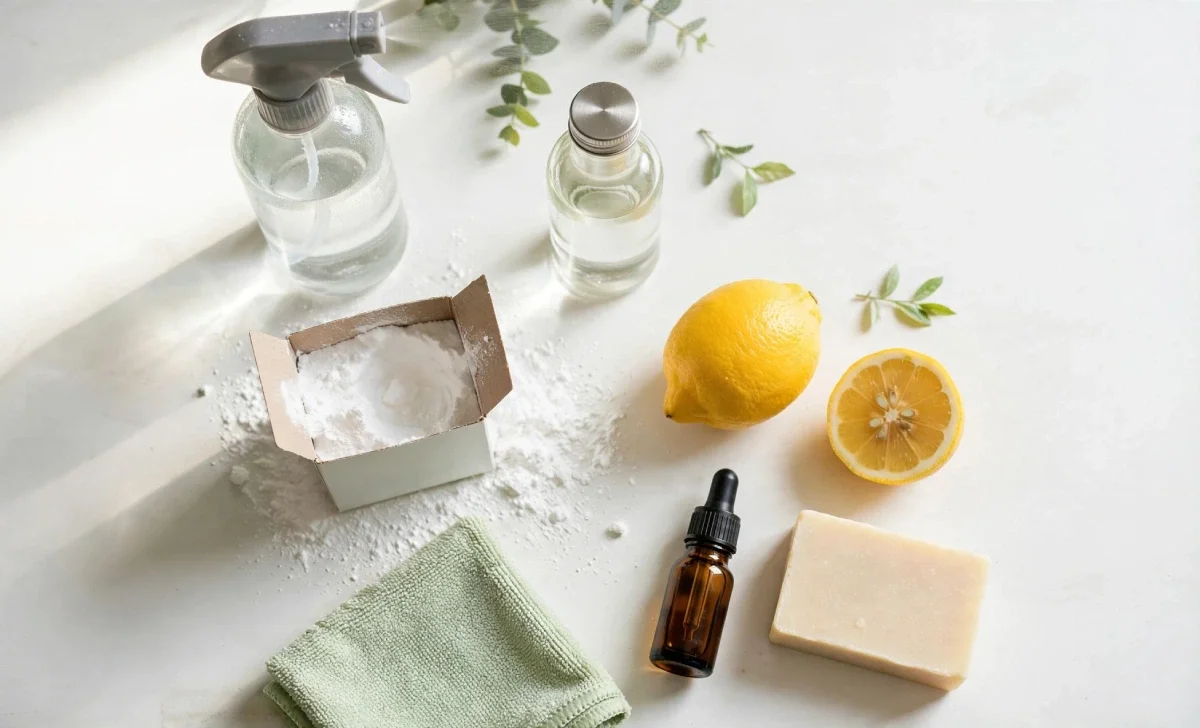
If the smell of a conventional spray cleaner has ever given you a headache or made your eyes water, you're not imagining things. Many store-bought formulas rely on chemicals that can irritate your skin, lungs, and sinuses, and repeated exposure adds up over time. The good news: natural household cleaning solutions handle most everyday jobs just as well, often for a fraction of the cost.
This guide covers the science behind why natural ingredients clean, how to use them room by room, ten DIY recipes with exact measurements, the store-bought brands worth buying, and the safety rules you shouldn't skip. Whether you want to mix your own sprays from vinegar and baking soda or simply choose a better bottle off the shelf, you'll find what you need here.
Key Takeaways
- Natural cleaners can match conventional products for most household tasks, and in some cases work better.
- Five to seven core ingredients — vinegar, baking soda, castile soap, lemon, and a few others — replace an entire cabinet of speciality cleaners.
- A gallon of white vinegar and a box of baking soda cost less than a single bottle of name-brand cleaner and last far longer.
- Roughly 73% of consumers say they're willing to pay more for sustainably made cleaning products.
- Look for EPA Safer Choice, Green Seal, or EWG Verified labels — these are the certifications actually worth trusting.
- Some combinations (bleach and ammonia, vinegar and castile soap) are dangerous or counterproductive. Know the rules before you start mixing.
Why Switch to Natural Household Cleaners?
The Problem With Conventional Cleaners
Many mainstream cleaning products contain ammonia, chlorine bleach, phthalates, formaldehyde-releasing preservatives, and synthetic fragrance blends. These ingredients can trigger headaches, skin irritation, and breathing problems, and they're a meaningful contributor to poor indoor air quality — cleaning activity alone accounts for close to 20% of indoor pollution. People with asthma or chemical sensitivities tend to notice the effects fastest, but the exposure adds up for everyone in the household. Many of these chemicals also don't break down easily once they're rinsed down the drain, which means they linger in water systems long after they've left your home.
The Rise of Natural Cleaning
This isn't a passing trend. The global natural household cleaners market was valued at roughly $37.23 billion in 2025 and is projected to reach $49.19 billion by 2031, growing at a 4.67% compound annual rate. Households that switch tend to stay switched — once people find a natural routine that works, they rarely go back to their old products. Even major manufacturers are reformulating with plant-based surfactants to keep up, and online sales of these products are growing faster than the category overall, at close to 5.85% a year.
The Money You'll Save
A gallon of white vinegar and a box of baking soda together cost less than one bottle of a name-brand all-purpose cleaner, and they'll outlast it many times over. Once you've got five or six pantry staples on hand, you can make an entire cleaning kit — surface spray, drain cleaner, scrub paste, and glass cleaner — for a few dollars.
Essential Natural Cleaning Ingredients
Here's what to actually buy, and why each one works.
White Vinegar — The All-Purpose Workhorse
Vinegar's acidity is what makes it effective: it breaks down mineral deposits, cuts through soap scum, and helps dissolve grease. A simple 50/50 mix of vinegar and water handles most daily surface cleaning, dissolves hard-water spots on faucets and glass, descales coffee makers and kettles, and cuts through grease on stovetops.
Skip it on natural stone. Granite, marble, and quartz are damaged by acid — vinegar will etch the surface over time. Also, never store vinegar and castile soap in the same bottle; the acid curdles the soap and ruins both.
Baking Soda — Gentle Scrub andOdourr Eater
Baking soda is a mild abrasive, fine enough to scour grime without scratching most surfaces, and it neutralises odours rather than covering them up. Make a paste with water for sinks, tubs, and baked-on grime. Sprinkle it dry on carpet, let it sit for 15 minutes, then vacuum. Keep an open box in the fridge to absorb odours.
One note: mixing vinegar and baking soda produces a satisfying fizz, but the reaction mostly just creates salt water. Use them separately for actual cleaning power — the fizz is fun, not functional, outside of drain-clearing.
Castile Soap — The Real Cleaner
Vinegar and baking soda handle acid and abrasion, but castile soap is what actually lifts dirt and grease the way conventional detergent does. It's a concentrated plant-oil soap that dilutes into dozens of uses: a few drops in warm water works as dish or hand soap, and a tablespoon in a spray bottle makes an effective floor and counter cleaner. Dr Bronner's is the most widely available brand and comes in scented and unscented versions. Remember: keep it away from vinegar in storage and in the bottle.
Lemon — Brightener and Natural Bleach
Lemon juice is mildly acidic, similar to vinegar, but with a fresh scent and a light bleaching effect. Rub a cut lemon on a cutting board to deodorise it, use half a lemon dipped in salt to scrub stubborn pans, or run a lemon half through the garbage disposal to freshen the sink. Lemon juice applied to a white cloth and left in direct sunlight can also lift certain fabric stains.
Hydrogen Peroxide — Natural Disinfectant
Hydrogen peroxide is a solid alternative to chlorine bleach for whitening, stain removal, and killing mould in damp bathroom areas. Used at the right concentration, it's safe on most surfaces and doesn't leave the fumes or residue that bleach does.
Essential Oils — Scent and Antimicrobial Action
Tea tree, lemon, peppermint, and eucalyptus oils carry natural antibacterial properties and can boost the cleaning power of a DIY spray, while adding scent without synthetic fragrance. Grapefruit oil works well as an antiseptic, and lavender adds a mild antimicrobial effect with a calming scent. Ten to twenty drops per spray bottle is usually enough.
Use with care. Essential oils can trigger allergic reactions in sensitive individuals, and some essential oil-based cleaners have been shown to raise indoor formaldehyde levels. Always dilute properly, and never apply undiluted oil directly to a surface or your skin.
Citric Acid — The Descaler
Citric acid is the ingredient to reach for when vinegar's smell is a dealbreaker. It's excellent at dissolving limescale in kettles and coffee makers, works well on hard-water stains on shower glass, and can soften towels without the vinegar odour.
Room-by-Room Natural Cleaning Guide
Kitchen — Counters, Sinks, Appliances
Use a 50/50 vinegar-and-water spray for daily counter wipe-downs. For stuck-on stovetop grease, apply a baking soda paste and let it sit before scrubbing. To clear a slow drain, pour half a cup of baking soda down it, follow with half a cup of vinegar, let it fizz for 15 minutes, then flush with boiling water. Run a vinegar-and-water solution through your coffee maker's brew cycle every month or two to descale it, and send a lemon half through the garbage disposal to keep it smelling fresh.
Avoid vinegar on granite or marble countertops — reach for a castile soap solution instead.
Bathroom — Tubs, Tile, Toilets, Mirrors
Bathrooms are the toughest room to clean naturally, but a small combination of products handles nearly everything. Bon Ami powder cleanser works well on sinks, tubs, and tile without the harsh chemicals found in typical scouring powders. A baking soda paste tackles grout, while citric acid dissolved in water cuts through hard-water deposits on shower glass. Hydrogen peroxide is effective against mould and mildew in damp corners, and a vinegar-and-water spray with a microfiber cloth leaves mirrors and glass streak-free.
Floors — Wood, Tile, Laminate
For tile and vinyl floors, warm water mixed with a small amount of dish soap or castile soap works well. Sealed wood, tile, and laminate can also be cleaned with a plant-based floor cleaner formulated for the surface.
Avoid vinegar on real wood floors — the acid can dull the finish over time. Sweeping instead of wet-mopping when you can also helps preserve the surface and saves water.
Glass and Mirrors — Streak-Free Solutions
Combine distilled water, isopropyl alcohol, and a small splash of vinegar for a DIY glass cleaner that dries fast and streak-free. Wipe with a microfiber cloth rather than paper towels, which tend to leave lint behind.
DIY Natural Cleaning Recipes
All-Purpose Surface Cleaner
- 1 cup water
- 1 cup white vinegar
- 10–20 drops essential oil (optional)
Combine in a spray bottle and shake well. Use on most sealed surfaces. Skip natural stone.
Glass and Mirror Cleaner
- 1 cup distilled water
- 1 cup white vinegar
- 1 tbsp rubbing alcohol (optional, speeds up drying)
Combine in a spray bottle and apply with a microfiber cloth for a streak-free finish.
Scrubbing Paste for Sinks and Tubs
- ½ cup baking soda
- Water, enough to form a paste
Mix to a paste consistency, apply, scrub, and rinse. Add a few drops of castile soap for extra stain-fighting power.
Drain Cleaner and Deodoriser
- ½ cup baking soda
- ½ cup white vinegar.
Pour the baking soda down the drain, add the vinegar, let it fizz for 15 minutes, then flush with boiling water. Repeat for stubborn clogs.
Natural Carpet Deodoriser
- Baking soda
- 10–15 drops essential oil (optional)
Sprinkle over the carpet, let sit for 15 minutes, then vacuum thoroughly.
Wood Furniture Polish (sealed wood only)
- ½ cup olive oil
- ¼ cup white vinegar
- 10 drops lemon essential oil
- 1 cup water
Combine, apply with a soft cloth, and buff dry.
Soft Scrub Cleanser
- ½ cup baking soda
- 2–3 tbsp liquid castile soap
- 5 drops tea tree oil
Mix into a paste and use on tubs, sinks, and tile grout for stubborn buildup.
Citric Acid Descaler
- 2 tbsp food-grade citric acid
- 2 cups warm water
Dissolve and use to soak or wipe down kettles, coffee makers, and shower glass with hard-water buildup.
Fabric and Upholstery Freshener
- 1 cup water
- 2 tbsp white vinegar
- 8–10 drops essential oil
Combine in a fine-mist spray bottle. Test on a hidden patch of fabric first, then lightly mist upholstery or curtains.
Natural Disinfecting Spray
- 1 cup water
- ½ cup hydrogen peroxide (3%)
- 10 drops tea tree oil
Combine in a dark spray bottle (light breaks down hydrogen peroxide) and use on high-touch surfaces like doorknobs and light switches.
Store-Bought Natural Cleaners — What Professionals Use
Top-Rated Natural Cleaning Brands for 2026
All-Purpose Cleaners
- Method All-Purpose Cleaner — widely available, EPA Safer Choice certified
- Mrs Meyer's Multi-Surface Everyday Cleaner — plant-derived formula, multiple scent options
- Branch Basics Concentrate — concentrated and dilutable, with a short ingredient list
Bathroom
- Bon Ami Powder Cleanser — a long-standing non-toxic abrasive cleanser
- DDrBronner's Sal Suds — a concentrated soap effective on shower walls and tile
Floor Cleaners
- Method Squirt + Mop Hard Floor Cleaner — plant-based, no-rinse formula
- Better Life Naturally Dirt-Destroying Floor Cleaner — EWG Verified
Other Notable Brands
- Koala Eco — known for recycled packaging
- Everspring — roughly 98% biobased ingredients, ammonia-free
- Ecover — widely available plant-based formulas across categories
How to Spot Greenwashing
A "green" or "natural" label on a bottle doesn't guarantee the product is safer or more sustainable — plenty of brands use the language loosely. Look instead for actual certifications:
- EPA Safer Choice — the product meets EPA safety and environmental criteria
- Green Seal — independent, third-party verification of environmental claims
- EWG Verified — the full ingredient list has been checked against safety standards
If a label says only "natural" with no certification and no full ingredient disclosure, treat it as marketing language rather than a guarantee. Fragrance-free options are also worth seeking out if you or anyone in your household is sensitive to scent.
Safety, Warnings, and What to Avoid
Never mix ammonia and bleach. This combination produces chloramine gas, which is toxic and can be dangerous in an enclosed space.
Don't store vinegar and castile soap together. The acid curdles the soap and makes both ineffective.
Avoid vinegar on natural stone — granite, marble, and quartz can be etched by the acid.
Avoid vinegar on real wood floors, which can lose their finish over repeated exposure.
Use essential oils carefully. They can trigger allergic reactions and, in some cases, contribute to higher indoor formaldehyde levels. Dilute properly and test on a small area first.
As a general rule, read ingredient lists before combining any products, keep cleaners out of reach of children and pets, and test new mixtures on an inconspicuous spot before using them broadly.
Conclusion
Five to seven ingredients — vinegar, baking soda, castile soap, lemon, hydrogen peroxide, citric acid, and a few essential oils — can replace nearly everything in a conventional cleaning cabinet. Natural cleaning isn't a compromise: for many jobs, it performs just as well as chemical alternatives, costs less, and cuts down on the chemical exposure in your home. It won't replace every product for every job, but it's a solid place to start.
Pick one recipe from this guide — the all-purpose spray is the easiest place to begin — and build out your kit from there. Most people who make the switch don't go back.
Frequently Asked Questions
Do natural cleaning products actually work?
Yes, for most everyday cleaning tasks. Vinegar cuts grease and mineral deposits, baking soda scours without scratching, and castile soap provides genuine cleaning power comparable to conventional detergent.
Is vinegar a disinfectant?
Vinegar has some antibacterial properties, but it isn't a registered disinfectant. Testing has shown 5% vinegar achieves a log reduction of roughly 2.1 to 2.9 against certain bacteria — helpful, but not equivalent to true disinfection. For situations that call for disinfecting, use hydrogen peroxide or a commercial, EPA-registered natural disinfectant.
What surfaces should I avoid cleaning with vinegar?
Skip vinegar on natural stone (granite, marble, quartz), real wood floors, cast iron, and aluminium since the acid can etch or discolour these surfaces.
Are natural cleaners safe around pets and children?
Generally, yes, though not every natural ingredient is automatically harmless. Some essential oils, including tea tree and peppermint, can be toxic to cats and dogs. Always check an ingredient before using it around pets, and store all cleaners out of reach.
How much money can I save with DIY natural cleaners?
A gallon of white vinegar and a box of baking soda together cost less than a single bottle of name-brand cleaner and will last through many cleaning sessions.
What's the best natural all-purpose cleaner recipe?
A 1:1 mix of white vinegar and water in a spray bottle handles most surfaces. Add 10–20 drops of essential oil if you want scent.
Can I mix vinegar and baking soda for cleaning?
The fizzing reaction is mostly for show — it produces salt water rather than a stronger cleaner. Use the two separately, and save the combination specifically for refreshing drains.
What certifications should I look for in natural cleaners?
EPA Safer Choice, Green Seal, and EWG Verified are the three worth trusting. They each represent independent, third-party review of a product's safety and environmental claims.