
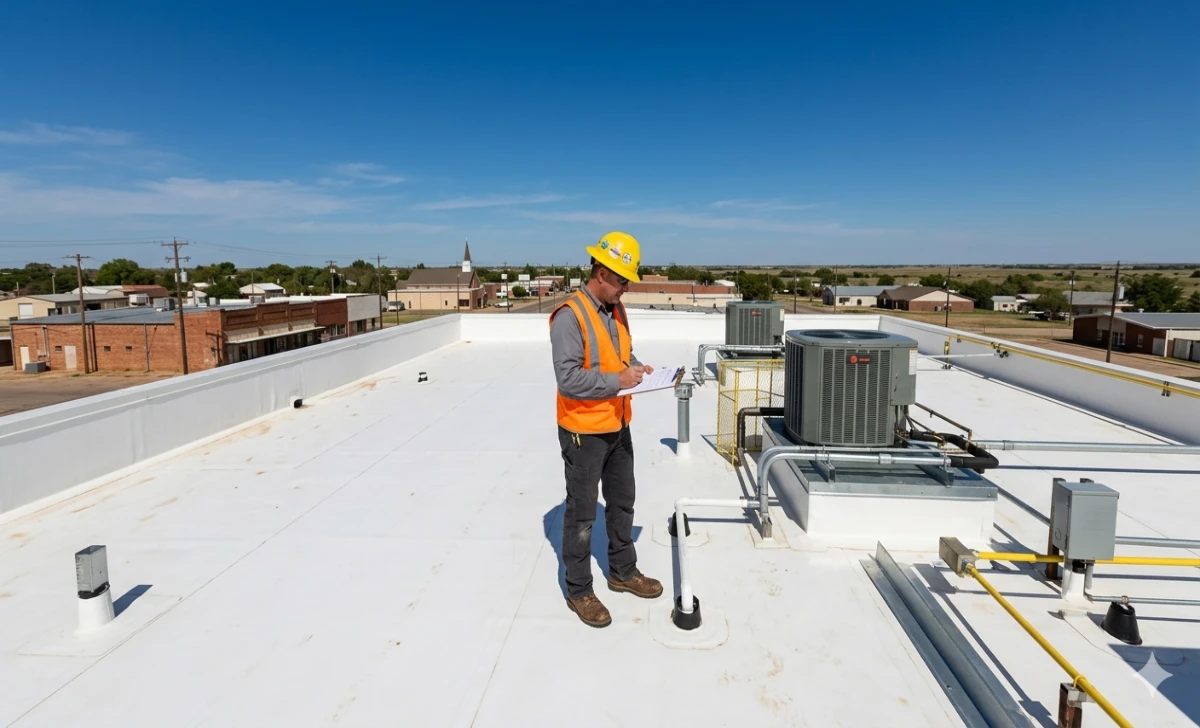
Running a business in Tolar means dealing with Texas weather on your roof every single day. Intense summer heat, sudden hailstorms, and hard-hitting rain all wear on your building faster than most people expect. When your roof starts to fail, it never stays a “roof problem” for long. Water gets inside, operations slow down, and you end up paying far more than you would have with a simple maintenance routine.
A commercial roof maintenance checklist gives you a clear, repeatable process to catch small problems before they turn expensive. Done consistently, it helps your roof last longer, keeps your energy bills in check, and gives you solid documentation if you ever need to file an insurance claim. This guide walks you through exactly what to check, when to check it, and what to watch for based on the real conditions Tolar businesses face.
Why Roof Maintenance Is Different for Texas Businesses
Commercial roofs in Texas age differently than those in cooler climates. Flat and low-slope roofs, which are common on retail strips, warehouses, and office buildings in Tolar, absorb intense UV radiation all summer. That heat accelerates membrane degradation, dries out sealants, and can cause materials to shrink or split at the seams.
Then come the storms. Hail punches holes in membranes. High winds peel back flashings. Heavy rain exposes every weak point at once. If your roof hasn’t been checked since the last storm season, there’s a good chance something has already shifted.
There’s also a second-order effect most owners overlook: wet insulation. When moisture works its way under the membrane, your building’s insulation absorbs it silently. Your HVAC system works harder, energy bills creep up, and you often don’t connect the two until the problem is already serious. At that point, you’re not just fixing a roof. You’re replacing insulation, dealing with potential mold, and possibly handling water-damaged inventory or equipment.
Consistent maintenance prevents all of that. And for businesses still under a roofing warranty, many manufacturers require documented inspections to keep the warranty valid. Skip those, and you could lose coverage at the exact moment you need it most.
Your Commercial Roof Maintenance Checklist
The most useful way to approach this is to split your inspection into two parts: what you check from inside the building and what you examine on the roof itself. Start inside. Interior signs often show up before the roof visibly fails, and they tell you exactly where to focus when you get outside.
Interior Checks: Your First Warning System
Walk through your space after any significant rainfall and look for these signs:
- Water stains or discoloration on ceiling tiles or drywall
- Musty smells or visible mold near walls and ceilings
- Peeling paint or bubbling finish on interior walls
- Damp spots on floors near exterior walls
When you find any of these, mark the location precisely. A photo on your phone with a timestamp is enough. That information helps a roofing contractor zero in on the problem area without spending time searching.
Early interior signs are the cheapest version of a problem you’ll ever deal with. A water stain you find today might be a thirty-minute repair. The same issue ignored for another season can mean structural damage, mold remediation, and lost inventory.
Exterior Checks: What to Look for on the Roof Surface
For the physical roof inspection, the safest approach for most business owners is to bring in a qualified commercial roofing contractor at least once a year, and do a quick ground-level visual yourself after major storms. If you do go up, use proper fall protection and never go alone.
Here’s what a thorough commercial roof inspection checklist covers:
Debris and drainage
- Clear all leaves, branches, dirt, and trash from the roof surface
- Check every drain, gutter, scupper, and downspout for clogs
- Look for ponding water, which is any standing water that remains more than 48 hours after rain
Ponding water is one of the most common and damaging problems on flat roofs in North Texas. It adds structural load, speeds up membrane wear, and creates the exact conditions where leaks develop over time.
Membrane and surface condition
- Look for cracks, tears, blisters, or seams pulling apart
- On older single-ply roofs (TPO, EPDM, PVC), check for shrinkage or surface cracking
- Note any areas where the membrane looks discolored or soft underfoot
Flashings and penetrations
- Inspect flashings around HVAC units, vents, pipes, and roof edges
- Look for cracked sealant, loose metal, or gaps where flashing has pulled away
- Check pitch pockets and expansion joints for proper sealing
Flashing failures are the leading source of commercial roof leaks. Sealants dry out faster in Texas heat, and once a gap opens, water finds it.
Rooftop equipment and foot traffic areas
- Check supports and flashings around HVAC equipment and solar panels
- Look for scuff marks, punctures, or wear patterns in high-traffic areas
- Confirm load-bearing areas haven’t been stressed by heavy equipment over time
Biological growth
- Look for algae, moss, or lichen on the roof surface
- These hold moisture against the membrane and speed up wear
How Often to Run Through This Checklist
For most Tolar businesses, twice-yearly professional inspections work well as a baseline. Spring is the right time to assess winter damage and prepare for storm season. Fall lets you clear debris and check flashings before cold weather sets in.
In between those inspections, a quick visual check from ground level after any major storm is good practice. You don’t need to go up on the roof. Just look for obvious changes: missing flashing, displaced materials, or anything that wasn’t there before the storm.
If you want to understand how winter freeze-thaw cycles specifically damage roof materials, this piece on winter roof damage from freeze-thaw conditions explains the mechanics well, even though it focuses on Virginia. The principles apply whenever temperatures swing below freezing, which does happen in North Texas.
Common Roof Types in Tolar and What Fails First
Most commercial buildings in Tolar use one of three main roof types: single-ply membrane (TPO or EPDM), built-up roofing (BUR), or metal. Each one has a different failure pattern.
Single-ply membranes are the most common on newer flat-roof buildings. They’re lightweight and efficient, but their seams are the weak point. Heat expansion and contraction over Texas summers eventually stresses those seams, especially around penetrations.
Built-up roofing is older and heavier, often found on long-standing commercial buildings. It tends to be durable but can develop splits and blisters as the underlying layers age. Drainage issues hit BUR roofs especially hard.
Metal roofing holds up well in Texas conditions and is a popular choice for warehouses and agricultural buildings in the area. If you’re considering metal roofing for a Central Texas property, this guide on metal roofing in Central Texas covers material options and what to expect in the local climate.
The Link Between Maintenance and Insurance Claims
Keeping good maintenance records does more than just help you track your roof’s condition. It directly affects your ability to make a successful insurance claim after a storm.
When hail or wind causes damage, insurers want to know the roof was in reasonable condition before the event. A pattern of documented maintenance shows that the damage was caused by the storm, not by years of neglect. Without that paper trail, claims get complicated.
A simple maintenance log, with dates, photos, and notes from each inspection, takes about ten minutes to update after any visit. Over several years, it becomes strong evidence of how the roof was cared for. If you ever need to navigate a commercial roof insurance claim, having that documentation ready will save you significant stress. This overview of roof insurance claims explains what the process looks like and how proper documentation supports your case.
Signs That Go Beyond a Maintenance Fix
Some findings during your inspection are more than routine. These warrant a professional evaluation as soon as possible:
- Multiple ponding areas that don’t drain after 48 hours
- Visible membrane splitting across a large surface area
- Widespread flashing failure around several penetrations
- Interior water stains appearing in multiple unconnected locations
- Any structural deflection or soft spots you can feel underfoot
At this point, you’re past maintenance and into repair or replacement territory. A qualified contractor can tell you whether targeted repairs are enough or whether the roof is approaching the end of its useful life. On a well-maintained flat roof in Texas, that lifespan runs roughly 20 to 25 years for single-ply systems and 30 or more for metal.
FAQs
How often should I inspect my commercial roof in Tolar or North Texas?
Twice a year is the minimum, ideally in spring and fall. Add a quick visual check after any major storm event. If your roof is older or has a known problem area, more frequent checks make sense.
What are the early warning signs of roof problems inside the building?
Water stains on ceiling tiles, musty smells, peeling paint near exterior walls, and damp spots on floors after rain are all signs that water is getting through somewhere. These often show up before you see any visible damage on the roof surface.
Can I handle commercial roof maintenance myself or do I need a pro?
Ground-level visual checks and clearing accessible gutters are things most owners can handle safely. Anything that requires walking on the roof, making repairs, or assessing membrane condition is better left to a licensed commercial roofing contractor. Safety matters, and so does avoiding warranty issues from unauthorized work.
How does regular maintenance affect energy costs and roof lifespan?
Wet insulation forces your HVAC system to work harder, which raises energy costs noticeably over time. Keeping drainage clear and the membrane intact prevents moisture from reaching the insulation layer. A well-maintained roof also reaches its full lifespan instead of failing years early, which is a significant cost difference when you’re looking at a full replacement.
Disclaimer: This article is intended for general informational purposes. Roofing conditions vary by building, material, and local climate. Always consult a licensed commercial roofing contractor for inspections, repairs, or replacement decisions specific to your property.