Most people think contemporary design is just another name for modern design, and that it means white walls, hard surfaces and very little warmth. Neither is true. Modern design is a defined historical movement, roughly the 1920s to the 1960s. Contemporary design refers to whatever is current, so it changes as tastes change. Right now, that means clean lines softened by curves, warm neutral palettes, natural materials and sculptural furniture.
This guide sets out the rules behind the look, gives you colours and materials you can use, and walks through each room of the home. By the end, you will be able to tell the two styles apart, judge whether a room is working, and decide where to start.
Key Takeaways
- Contemporary means current and evolving. Modern means the fixed movement of roughly 1920 to 1960.
- Today's contemporary style is warm, textured and curved, not white and hard.
- Start with the 60-30-10 colour rule: 60% neutral, 30% secondary, 10% accent.
- Give each sight line one focal point and leave surfaces partly clear.
- Mix at least three textures in every room: one matte, one woven, one hard or reflective.
- Layer your lighting: ambient, task and accent, with dimmers throughout.
- Budget in three tiers: refresh, single room or whole home.
1. What Is Contemporary Interior Design?
A clear definition
Contemporary interior design is the design language of the present moment. It favours clean lines, warm neutral palettes, natural materials, sculptural forms and a deliberately edited, uncluttered look. Unlike modern design, it does not belong to one period. It changes as tastes change.
Why the meaning of "contemporary" keeps shifting
Because the word describes "now," the look of contemporary design has changed several times. Glossy minimalism dominated the 1990s. Glass and chrome arrived in the 2000s. Cool greys and stark whites followed in the 2010s. The 2020s brought a move toward warm woods, curved forms and visible texture. A room that looked fully contemporary in 2005 may look dated today, not because it was poorly designed, but because the style has moved on. [VERIFY: if you cite a specific trend-report year or publication, link it and add the date.]
The five traits that define it today
- Clean but softened lines. Straight edges remain, but corners are rounded, openings are arched, and fronts are fluted.
- A tonal neutral base. Walls, floors and large furniture stay in one colour family, with restrained accents on top.
- Natural and tactile materials. Wood, stone, plaster, linen and wool take priority over plastic and high gloss.
- Intentional negative space. Empty areas are treated as part of the design, not as a gap to fill.
- Statement lighting and sculptural form. One piece, such as an arc lamp or a curved chair, often does more work than several small objects.
2. Contemporary vs Modern (and Other Styles)
The two words are used interchangeably online, which makes it hard for readers to tell them apart. The table below sets out the main differences.
| Modern (roughly 1920s–1960s) | Contemporary (the present) | |
|---|---|---|
| Time period | A fixed historical movement | Always current and evolving |
| Lines | Strict and rectilinear | Clean, but curved or softened |
| Colour | Earthy tones with primary accents | Warm neutrals with muted accents |
| Materials | Chrome, glass, plastic, teak | Stone, plaster, oak, bouclé, linen |
| Ornament | None | Sculptural form takes the place of ornament |
| Feel | Crisp and graphic | Warm, tactile and calm |
| Ceilings | Usually bare | Often plastered, arched or ribbed |
Contemporary against the styles it borrows from
Many contemporary rooms borrow from neighbouring styles. The second table helps you place a room.
| Style | How it differs from contemporary | How to tell |
|---|---|---|
| Transitional | Blends traditional and modern elements, with more classic detail | Mouldings, traditional upholstery, warmer wood tones |
| Scandinavian | Light woods and hygge-style textiles, with fewer sculptural statements | Pale oak, wool throws, simple forms |
| Japandi | Joins Japanese restraint with Scandinavian warmth, often with low furniture | Low profiles, earthy clay tones, visible natural imperfection |
| Organic modern | Leans heavily on natural shapes and materials | Rounded furniture, rattan, live-edge wood |
| Minimalism | Removes almost everything | Very few objects, little or no texture |
| Warm minimalism | Keeps the calm of minimalism but adds texture and warm light | Few objects, but at least three textures per room |
A quick self-test
If your room has a neutral base, one curved or sculptural piece, natural materials and layered light, you are leaning contemporary. If it has strict geometry, chrome and primary colours, it leans mid-century modern. If it is almost empty, it leans minimalist. Most good rooms sit somewhere between these labels, and that is normal.
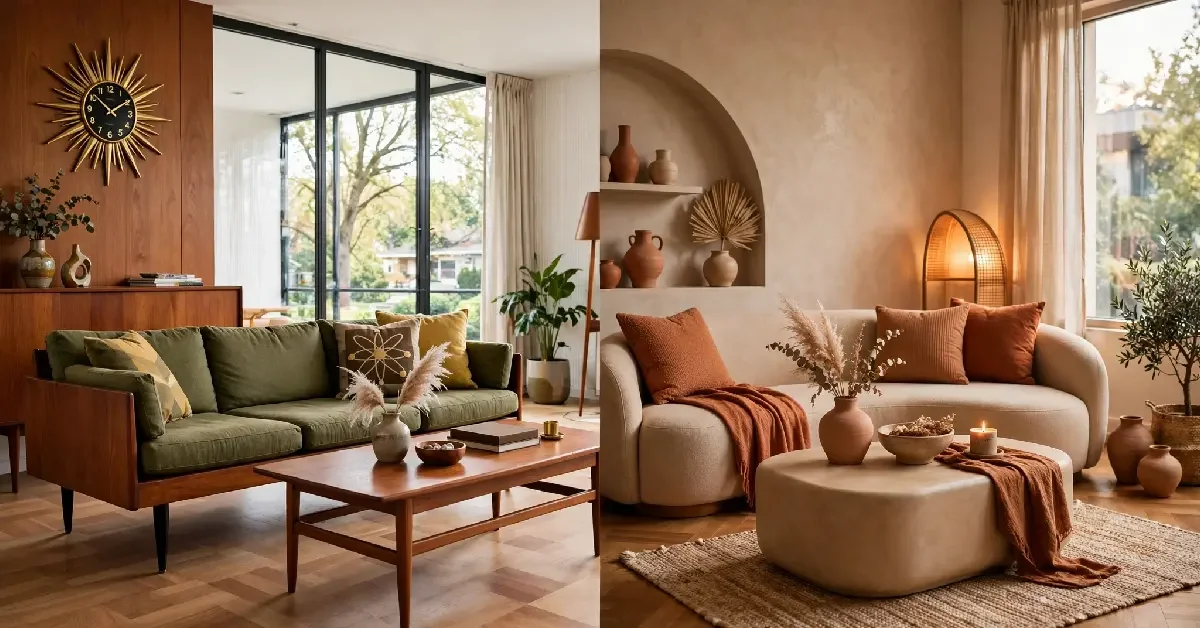
3. The Core Principles of Contemporary Design
These are the rules designers use most often. Each can be checked by eye.
- Use softened forms. Choose a curved armchair, a rounded side table or an arched doorway. Use at least one soft line in every room.
- Treat negative space as a material. As a working rule of thumb, leave about 30% of horizontal surfaces clear. Give each sight line one focal point.
- Let form follow function. Every piece should justify its footprint. In small rooms, choose multi-purpose furniture, such as a bench with storage or a bed with drawers.
- Use contrast on purpose. Pair hard with soft, matte with reflective and light with dark. Make the contrast deliberate, not accidental.
- Treat light as a material. Daylight comes first. Artificial light should be layered, warm and dimmable.
[IMAGE: Annotated room photo with callouts. Alt: "Contemporary living room annotated to show negative space, a sculptural pendant and layered textiles"]
4. The Contemporary Colour Palette
Foundation neutrals
Warm white, greige, oat, sand, mushroom, clay and taupe form the base of most contemporary schemes. They read as calm and warm, and they let texture carry the room.
The 60-30-10 rule
Use roughly 60% dominant neutral on walls and large upholstery, 30% secondary tone in wood, stone or textiles, and 10% accent. Accent colours in this style are muted: ink blue, olive, rust, terracotta or charcoal.
Worked example: In a living room, warm white walls and a greige sofa make up the 60%. An oak coffee table and a clay-toned rug make up the 30%. A single ink-blue cushion, a ceramic vase and a dark-framed print make up the 10%.
Warm or cool?
Choose your palette by light. Rooms that face north receive cooler light, so warmer neutrals such as oat and clay balance them. Rooms that face south receive warm light, so cooler neutrals such as greige and soft grey stop the room feeling heavy. [VERIFY: if you add a quoted light-temperature guide, cite the source and date.]
Finishes matter
A matte or limewashed wall reads as contemporary. A high-gloss finish on the same wall often reads as dated. Plaster, limewash and eggshell or satin paints give the softness the style depends on. Keep gloss for small, deliberate accents such as a lacquered cabinet or a tile splashback.
5. Materials and Textures
Natural materials
Oak, walnut, travertine, limestone, linen, wool, bouclé and cane appear in most contemporary rooms. They age well, and they bring the warmth that stops the style from feeling cold.
Engineered and industrial finishes
Microcement, blackened steel, reeded or frosted glass, fluted timber and sintered stone give a sharper edge. Use them as contrast, not as the main material. One blackened steel shelf or a fluted cabinet front is often enough.
The three-texture rule
Every room should include at least one matte surface, one woven or soft surface and one hard or reflective surface. In a living room, that might look like this: a bouclé armchair (soft), an oak coffee table (matte, warm) and a brass floor lamp (reflective).
Sustainable and healthy choices
Choose timber with a recognised certification, such as FSC where it is available. Look for low-VOC paints and finishes, which reduce indoor air pollutants. Natural fibres and well-made solid pieces tend to last longer than fast furniture. Certification labels and their standards vary by region, so check the claim before you rely on it. [VERIFY: cite your national environment agency or certification body for any VOC or certification guidance.]
[IMAGE: Material close-up grid. Alt: "Material samples for contemporary design: travertine, oak, bouclé, linen, blackened steel and reeded glass"]
6. Furniture and Layout
What contemporary furniture looks like
Look for low profiles, tapered or plinth bases, curved backs, visible joinery and minimal hardware. A good sofa in this style has a clean arm, a relaxed seat and a base that lifts the body visually off the floor.
Scale and proportion
The most common mistake is buying furniture that is too small for the room. As a guide, a sofa should be wide enough to seat the room's main group without touching both walls, and a rug should be large enough that at least the front legs of every seating piece sit on it. [VERIFY: if you publish specific dimension ranges, check them against a named manufacturer or trade guide.]
Zoning an open plan
In open-plan spaces, use a large rug, a pendant or a low piece of furniture to mark each zone. Keep sight lines clear, so a person in one area can still see the room's main features.
Invest or save
Invest in the pieces you use every day: the sofa, the bed, the dining table and the main lighting. Save on accessories, side tables, textiles and art prints, which are easier to replace as your taste develops.
[IMAGE: Floor plan diagram. Alt: "Open-plan living and dining zoning diagram showing rug placement and pendant lighting"]
7. Lighting in Contemporary Interiors
Lighting does more to shape a contemporary room than most people expect. A room lit by one central fixture almost always feels flat.
Four layers of light
- Ambient: general light for the whole room, such as recessed downlights or a ceiling wash.
- Task: focused light for reading, cooking or working, such as a desk lamp.
- Accent: light that highlights a feature, such as a picture light or uplight.
- Decorative: a light that is also an object, such as a sculptural pendant or an arc lamp.
Sculptural and statement fixtures
Arc floor lamps, linear chandeliers, ribbed glass pendants and plaster wall sconces fit the style well. Choose fixtures for their shape as much as their output.
Bulb temperature and control
For living spaces, choose bulbs in the 2700K to 3000K range, which gives warm white light. Fit dimmers wherever you can, and avoid relying on a single ceiling fitting. [VERIFY: confirm colour-temperature guidance against a current lighting standard before publishing.]
| Room | Ambient | Task | Accent | Decorative |
|---|---|---|---|---|
| Living room | Ceiling wash or downlights | Floor lamp by reading chair | Picture light on artwork | Arc lamp or sculptural pendant |
| Kitchen | Downlights | Under-cabinet strip | Pendant over island | Linear pendant |
| Bedroom | Ceiling fitting on dimmer | Bedside reading lamp | Wall uplight | Plaster sconce pair |
8. Contemporary Design, Room by Room
Living room
Choose a low sofa, one sculptural chair, a tonal rug, a single focal artwork and layered lighting. Keep the coffee table low so the sight line across the room stays open.
Bedroom
An upholstered platform bed works well as the anchor. Layer blackout curtains with a sheer panel. Use bedside sconces rather than table lamps to keep the nightstand clear. Style the nightstand with one lamp, one object and nothing else.
Kitchen
Choose slab-front cabinets with integrated handles or push-to-open doors. A stone splashback and a fluted island add texture without clutter. Warm under-cabinet lighting makes the room feel calm in the evening.
Dining room
A plinth or pedestal table keeps the floor visible beneath it. Upholstered chairs add softness. Hang one pendant at the correct height over the table, usually with the bottom of the fitting roughly 75 to 90 cm above the tabletop. [VERIFY: confirm the pendant height guidance against a current lighting reference.]
Bathroom
Large-format tiles, a floating vanity, brushed or blackened metal fittings and a backlit mirror create a clean base. Add one natural element, such as a wooden stool or a plant, to keep the room warm.
Home office
Choose hidden storage, a warm task lamp and soft textiles to reduce echo. Keep one personal object on the desk, so the room feels lived in rather than staged.
Small spaces and rentals
Mirrors reflect light and make a room feel larger. Vertical storage keeps the floor clear. Multi-purpose pieces reduce the number of objects you need. For rentals, choose removable options: peel-and-stick wallpaper, plug-in sconces and freestanding shelving.
[IMAGE: Living room, Alt: "Warm contemporary living room with a low sofa, sculptural armchair and tonal wool rug"] [IMAGE: Kitchen, Alt: "Contemporary kitchen with slab-front cabinetry, stone splashback and fluted island"]
Do this: choose one sculptural piece per room, use three light sources and leave surfaces partly clear. Avoid this: matching furniture sets, overhead lighting only and rugs that are too small.
9. Styling and Accessories
Styling is where many rooms lose their calm. Keep it edited.
- Art: One larger piece usually works better than a crowded gallery wall in this style.
- Textiles: Two or three cushions on a sofa, plus one throw. Choose tonal colours rather than matching sets.
- Greenery: One sculptural plant, such as a fiddle leaf fig, olive tree or snake plant, usually beats many small pots.
- Objects: Group objects in threes, with varied heights and an odd number of items.
- The editing rule: Remove one item before you add one.
10. Common Mistakes to Avoid
Too many metals or finishes. Why it fails: the room looks busy and undecided. Fix: choose one main metal and one accent.
Matching furniture sets. Why it fails: the room looks like a showroom. Fix: mix a sofa, a chair and a table from related tones and shapes.
Overhead lighting only. Why it fails: the light is flat and harsh. Fix: add table lamps, wall lights and dimmers.
Art hung too high. Why it fails: the artwork feels disconnected from the furniture. Fix: hang the centre of the piece at roughly eye level, about 145 cm from the floor. [VERIFY: confirm the eye-level guidance against a current reference.]
Rugs that are too small. Why it fails: the furniture floats, and the room feels unanchored. Fix: choose a larger rug that sits under the front legs of the seating.
Cold white walls without texture. Why it fails: the room feels clinical. Fix: use limewash, plaster or a warm neutral paint, and add a textile.
Overcrowded surfaces. Why it fails: the eye has nowhere to rest. Fix: clear at least a third of each surface.
Trend pieces instead of good forms. Why it fails: the room dates quickly. Fix: buy simple, well-proportioned pieces and add trend items as accessories.
11. What Does It Cost? Budget Tiers
Costs vary widely by country, room size and specification. The three tiers below describe what each level usually includes. They are planning categories, not quotes. Always price with local suppliers.
| Tier | What it usually includes | Where to prioritise |
|---|---|---|
| Refresh | Textiles, lighting swaps, accessories, a new rug | Lighting and rug size |
| One room | Key furniture, paint or plaster finish, lighting plan | Sofa or bed, and the lighting layers |
| Whole home | Multiple rooms, built-in joinery, flooring and fittings | Consistency of palette and materials |
Where to save: accessories, side tables, art prints and textiles. Where to splurge: the sofa, bed, mattress, dining table and lighting.
[VERIFY: Before adding any price band, cite a named, dated source such as a Houzz or NKBA report, or a national statistics office. If you cannot source a figure, use qualitative language, such as "a full room costs considerably more than a refresh."]
12. Contemporary Design Trends for 2026
Industry sources currently point to a few clear directions: curved and sculptural forms, warm woods, textured plaster, tonal layering, natural stone and quieter technology integration. [VERIFY: link each trend to a named trade report, such as ASID, NKBA, Houzz or a major trade-show review, and add the publication date.]
What is fading
- Cold grey schemes
- High-gloss surfaces
- All-white minimalism
- Mixed-metal overload
- Fast, disposable furniture
[EXPERT: Quote from a practising designer on the shift away from cool neutrals. Include name, studio and permission.]
This section is reviewed each year. Update it after the main spring and autumn trade-show season.
13. How to Start: A 7-Step Action Plan
- Audit what you own. Remove anything you do not use or like.
- Fix the light first. Add layers, swap bulbs to 2700K to 3000K and fit dimmers.
- Set your 60-30-10 palette. Choose your neutral, secondary tone and accent.
- Anchor the room with one investment piece. A sofa, bed or table works well.
- Add texture in three places. Use one matte, one woven and one reflective surface.
- Clear surfaces, then style in threes. Keep the grouping loose and the number of objects small.
- Live with it for two weeks. Then adjust what still feels wrong.
14. Frequently Asked Questions
What is contemporary interior design? It is the design language of the present moment. It combines clean lines, warm neutral tones, natural materials and sculptural forms. Unlike modern design, it is not a fixed historical movement, so it changes as tastes change.
What is the difference between modern and contemporary interior design? Modern design is a defined movement of roughly the 1920s to 1960s, with strict lines and materials such as chrome and glass. Contemporary design is whatever is current. Today's contemporary style is softer, warmer and more textured than classic modern.
What are the main characteristics of contemporary design? Softened lines, a tonal neutral palette with restrained accents, natural materials, generous negative space, sculptural furniture and layered lighting. Rooms feel curated rather than decorated.
What colours are used in contemporary interiors? Warm white, greige, oat, sand, mushroom, clay and taupe form the base. Accents are muted: ink blue, olive, rust, terracotta or charcoal. The 60-30-10 rule is a reliable starting point.
Is contemporary design the same as minimalism? No. Minimalism strips a room back to essentials. Contemporary design is uncluttered, but not empty. It welcomes texture, art, plants and sculptural objects, as long as each is chosen with care.
Does contemporary design go out of style? The word itself cannot go out of date, because it describes the present. Individual expressions of the style can date, so focus on proportion, quality materials and good light rather than trend pieces.
What furniture is contemporary style? Low-profile sofas, curved or sculptural armchairs, platform beds, plinth and pedestal tables, sideboards with minimal hardware and lighting that works as an object. Good proportions and quality joinery matter more than brand names.
How do I make my living room look contemporary? Start with a warm neutral base. Add one well-scaled sofa and one sculptural chair, lay a tonal rug, use three light sources, hang one artwork at eye level and clear at least a third of horizontal surfaces.
Is contemporary design cold? It can be, if you rely on white walls, hard surfaces and overhead light alone. Add warmth through wood, bouclé or linen, a woven rug, warm 2700K to 3000K lighting and one organic form.
How much does contemporary interior design cost? Costs depend on location, room size and specification. A refresh is the entry point. A full room or a whole home costs considerably more. Get itemised quotes from local suppliers before you decide.
Conclusion
Contemporary design is a moving target, so learn the principles rather than chasing trends. Remember three things: choose a warm neutral base, give each room one sculptural statement and layer your light. Those habits will keep a room feeling current long after the next trend arrives.