
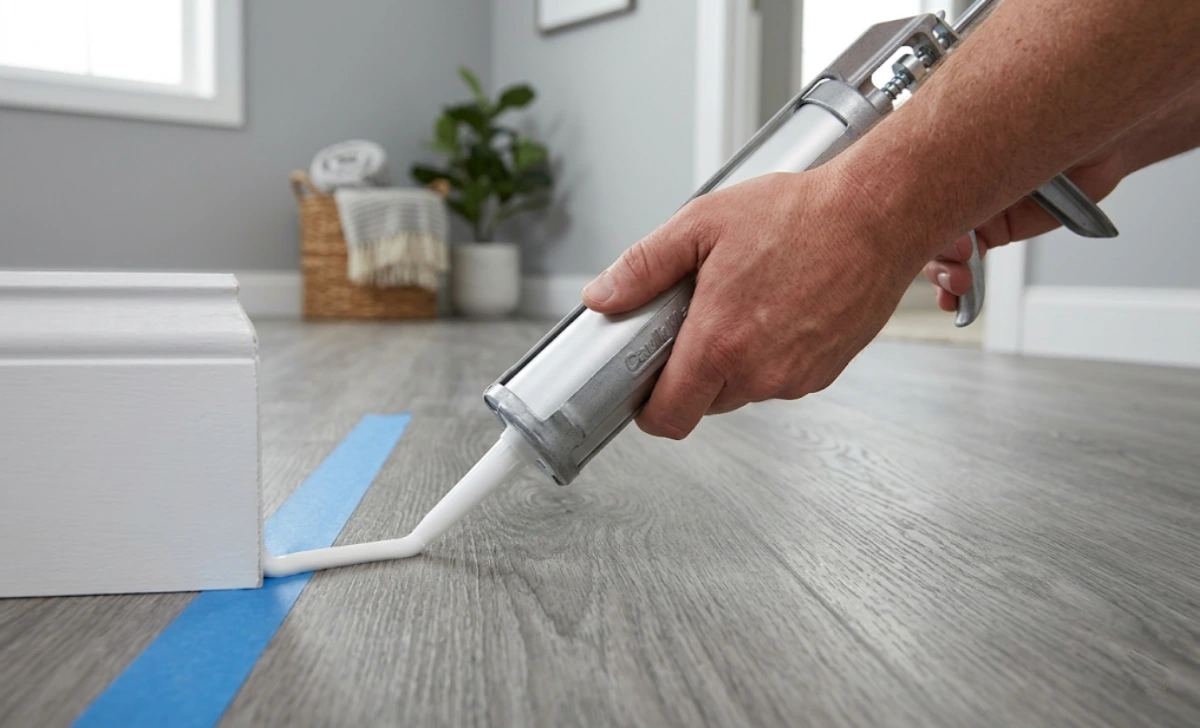
To caulk between baseboard and vinyl floor, apply a thin bead of flexible paintable caulk along the base of the trim where it meets the floor surface. Use painter’s tape for clean edges, smooth with a damp finger, and remove the tape while the caulk is still wet. Do not fill the expansion gap behind the baseboard.
You’ve installed your vinyl floor. It looks great. Then you notice it — that thin, uneven gap running along the bottom of the baseboard. Sometimes it’s barely a millimetre. Sometimes it’s wide enough to see daylight through. Either way, it bothers you.
So the question becomes: should you caulk it, and if so, how?
This guide gives you a straight answer — including the part most tutorials skip: when caulking is the wrong call entirely.
What is Caulk’s caulking between the baseboardyl Floor?
Caulking is the process of applying a flexible sealant to the gap between your baseboard trim and the surface of your vinyl floor. The goal is usually one of three things: cosmetic (closing an ugly gap), protective (blocking moisture, dirt, and drafts), or both.
It sounds simple. And usually it is — if you know what you’re doing. The trouble is that vinyl flooring, particularly luxury vinyl plank (LVP), behaves differently from tile or hardwood. It expands and contracts with temperature changes. That movement matters when you’re deciding whether and how to seal the edges.
Should You Caulk the Gap Between Baseboard and Vinyl Floor?
In most cases, yes — with one important condition.
If your baseboards sit directly on top of the finished floor (installed after the flooring), a thin bead of paintable caulk along the base creates a clean, sealed look that keeps dirt and insects out. It also stops cold drafts from creeping in along the perimeter, which is especially noticeable in older homes with less-than-perfect subfloors.
Cosmetically, it makes a significant difference. Even a well-installed floor can look unfinished if the gap between the trim and the floor is visible. A smooth, colour-matched caulk line reads as professional and intentional.
Practically, it also helps in kitchens, laundry rooms, and bathrooms where water on the floor could seep under baseboards and cause swelling or mould over time.
So yes — caulking is usually the right move. But the next section explains when it isn’t.
When NOT to Caulk Vinyl Flooring
This is where many DIYers go wrong, and it can be an expensive mistake.
Luxury vinyl plank flooring needs an expansion gap — typically 1/4 inch — around the perimeter of the room. This gap lets the floor move as it expands and contracts with seasonal temperature and humidity changes. Manufacturers, including Mohawk, COREtec, and Shaw, all specify this in their installation guidelines.
If you caulk directly into that expansion gap — especially with a rigid or semi-rigid product — you restrict the floor’s movement. Over time, that can cause planks to buckle, lift, or separate at the seams.
The key distinction: you’re caulking the gap between the baseboard and the floor surface, not filling the expansion gap itself. The baseboard should already be covering that expansion gap. Your caulk line sits at the very edge of the baseboard — on top of the floor — not behind it.
If your baseboard is floating (not nailed down, installed to move with the floor), skip the caulk entirely. In that setup, sealing the trim to the floor defeats the purpose of the floating installation method.
Also worth noting: if you’re still in the middle of a full flooring renovation — say you’re removing old carpet before laying vinyl — wait until everything is fully settled and acclimatised before you caulk. New flooring needs time to adjust to room conditions before the edges are sealed.
Best Types of Caulk for Vinyl Floors
Not all caulk behaves the same way, and the wrong choice will crack, peel, or look terrible within months.
Paintable Latex/Acrylic Caulk
This is the most popular option for baseboard caulking and the easiest to work with. It cleans up with water, accepts paint, and comes in a wide range of colours. It’s flexible enough for minor seasonal movement and bonds well to both wood trim and vinyl surfaces.
The main limitation: it’s not fully waterproof. In high-moisture areas, it can absorb water over time and break down.
Best for: Living rooms, bedrooms, hallways, and any low-to-medium moisture area.
Silicone Caulk
Silicone is waterproof, highly flexible, and very durable. It handles temperature swings well, which matters for floors near exterior walls or in unheated spaces.
The downside: most silicone caulk cannot be painted. It also requires a clean, dry, oil-free surface to adhere properly, and it’s harder to tool smoothly for beginners.
Best for: Bathrooms, kitchens, laundry rooms, and any area with regular water exposure.
Siliconized Acrylic (Hybrid) Caulk
This is the middle ground — paintable like acrylic but with better flexibility and moisture resistance than standard latex. For most homeowners doing baseboard work on vinyl floors, a siliconized acrylic is often the smartest pick.
Best for: Almost any room; a reliable all-around choice.
Colour-Matching Caulk
Several brands offer caulk in colours designed to match common trim shades: bright white, off-white, almond, grey, and more. If your baseboards are already painted and you’re not planning to repaint, colour-matched caulk gives you a cleaner result without the extra step.
Tools You Need
You don’t need much. Here’s a short list:
- Caulking gun (a basic model works fine for small jobs)
- Caulk (chosen based on the room type above)
- Painter’s tape (for clean lines)
- A damp cloth or sponge (for smoothing and cleanup)
- A caulk finishing tool or gloved finger (for shaping the bead)
- Utility knife or caulk remover (if replacing old caulk)
Step-by-Step: How to Caulk Between Baseboard and Vinyl Floor
Step 1 — Clean the Surface
Wipe the baseboard and floor edge with a clean, dry cloth. Remove any dust, dirt, or old caulk residue. If you’re replacing old caulk, use a utility knife or caulk removal tool to cut and peel it out completely. New caulk won’t adhere well to old, flaking sealant.
If there’s any grease or moisture — especially in kitchens or bathrooms — clean the area with isopropyl alcohol and let it dry fully before continuing.
Step 2 — Apply Painter’s Tape
Run a strip of painter’s tape along the floor, parallel to the baseboard, about 3–5mm away from it. This creates a clean boundary for your caulk line. You can also apply tape to the baseboard itself if you want a tight, defined edge on both sides.
This step takes two minutes and saves you twenty minutes of cleanup. Don’t skip it.
Step 3 — Load and Cut the Caulk Tube
Load your tube into the caulking gun. Cut the tip at a 45-degree angle — start with a smaller hole than you think you need. You can always widen it, but you can’t undo a tip that’s too wide. A small, precise opening gives you better control in a narrow gap.
Step 4 — Apply the Caulk
Hold the gun at roughly 45 degrees to the surface. Squeeze the trigger with steady pressure and move smoothly along the baseboard in one continuous motion. Don’t stop and restart unless you have to — joins in the bead are harder to smooth and more visible when dry.
Work in sections of about 3–4 feet at a time so the caulk doesn’t dry before you smooth it.
Step 5 — Smooth the Bead
Immediately after applying, run a damp finger or a caulk finishing tool along the bead to press it into the gap and create a concave, smooth surface. This also removes any excess. Wipe your tool or finger with a damp cloth between passes.
Step 6 — Remove the Tape
Pull the painter’s tape off while the caulk is still wet — not after it dries. Pull it back at a 45-degree angle, slowly and steadily. If you wait until it’s dry, you risk tearing the caulk edge.
Step 7 — Let It Cure
Check the product label for dry time. Most acrylic caulks are touch-dry within 30–60 minutes, but need 24 hours before painting. Full cure time is usually 24–72 hours. Avoid foot traffic along the edges while it sets.
Common Mistakes to Avoid
Using the wrong caulk in wet areas. Standard acrylic caulk in a bathroom or kitchen will absorb moisture and grow mould within months. Use silicone or a siliconized acrylic anywhere that sees regular water.
Filling the expansion gap. As covered above, caulk goes between the baseboard face and the floor surface, not behind the trim where the expansion space lives.
Applying over dirty or damp surfaces. Caulk needs a clean, dry surface to bond. Anything less and it’ll peel within weeks.
Using too large a tip opening. A fat bead applied to a narrow gap looks sloppy and is hard to smooth. Cut your tip small and increase the size only if needed.
Not using tape. Experienced finishers sometimes skip it. Beginners almost always regret it.
Painting too soon. If you’re applying paintable caulk, wait the full cure time before painting over it. Rushing this step causes the paint to crack along the caulk line.
Silicone vs. Acrylic Caulk for Vinyl Floors: A Quick Comparison
| Acrylic/Latex | Silicone | Siliconized Acrylic | |
|---|---|---|---|
| Paintable | Yes | No | Yes |
| Waterproof | No | Yes | Moderate |
| Flexibility | Moderate | High | Good |
| Ease of use | Easy | Moderate | Easy |
| Best for | Low-moisture rooms | Wet areas | Most rooms |
Seasonal Movement and Vinyl Floors
One thing worth understanding: LVP expands in warmer months and contracts in cooler ones. This movement is minor, but it’s real — especially in homes with significant temperature swings or near exterior walls.
A flexible caulk will absorb this movement without cracking. A rigid, non-flexible sealant won’t. This is another reason to avoid using grout or non-flexible gap fillers along baseboard edges on vinyl floors.
If you’re still deciding between LVP and another flooring type, it’s worth reading a detailed comparison — luxury vinyl plank versus laminate behaves differently in terms of moisture tolerance and movement, which also affects how you approach the finishing work around edges.
How to Maintain the Caulk Seal
A well-applied, good-quality caulk line should last several years before it needs attention. To keep it in good shape:
Clean it gently. Avoid abrasive scrubbers or harsh chemical cleaners along caulked edges. A damp cloth is enough for routine cleaning.
Check it annually. Look for cracking, peeling, or separation — especially in bathrooms and kitchens. Catching a small problem early takes five minutes to fix; ignoring it for a year can mean moisture damage behind the trim.
Recaulk when needed. Remove all old caulk, clean the surface thoroughly, and apply fresh product. Caulking over old, failing caulk never lasts.
Renter-Friendly Tip
If you’re renting and want to close gaps without permanent changes, look for removable or paintable caulk strips — peel-and-stick foam or vinyl products that mimic the look of caulk but can be removed cleanly. They won’t be as durable or seamless, but they’re a fair compromise if you need to restore the original condition.
Final Verdict
Caulking between baseboard and vinyl floor is a simple job that makes a real difference — in how the floor looks, how well it holds up to everyday wear, and how protected it is against moisture and drafts.
The keys: use the right caulk for the room, don’t fill the expansion gap, prep the surface properly, and take your time with the tape and smoothing steps. Done right, the result looks intentional and professional with very little effort.
And if you’re working on a broader flooring project — anything from sealing a garage floor to finishing the last details on a new vinyl installation — the same principles apply: the finish work is what separates a good result from a great one.
FAQs
Do you have to caulk between the baseboard and the vinyl plank flooring?
Not always, but it’s recommended in most cases. It improves the appearance, keeps dirt and insects out, and adds a layer of moisture protection. Skip it only if your trim is floating (designed to move with the floor) or the manufacturer specifically advises against it.
What is the best caulk for vinyl plank flooring baseboards?
In most rooms, a siliconized acrylic caulk gives the best balance of flexibility, paintability, and moisture resistance. In bathrooms or kitchens, go with 100% silicone for proper waterproofing.
How do I fill a large gap between my baseboard and vinyl floor?
For gaps wider than about 1/4 inch, caulk alone may not be the right fix. Consider adjusting or replacing the baseboard, or adding shoe moulding (also called quarter-round trim) to cover the gap before caulking the edge of the moulding to the floor.
Can I caulk over old caulk?
Only if the old caulk is still fully adhered and in good shape. If it’s cracking, peeling, or discoloured, remove it entirely before applying fresh product. Caulking over failing caulk adds thickness without fixing the underlying problem.
How long does caulk last between baseboards and vinyl floors?
With good preparation and a quality product, a caulk line in a dry room can last 5–10 years. In wet areas, plan to inspect and replace it every 2–3 years.
Should I use shoe moulding instead of caulk?
Shoe moulding (quarter-round trim) is a better solution for large or uneven gaps. Caulk works best on small, consistent gaps — 1/8 inch or less. For bigger issues, the trim covers more cleanly, and you can then add a thin caulk line at the edge of the moulding.
Ready to get started? Compare the best flexible caulks for vinyl plank flooring and find the right one for your room type — the right product makes every step easier.