
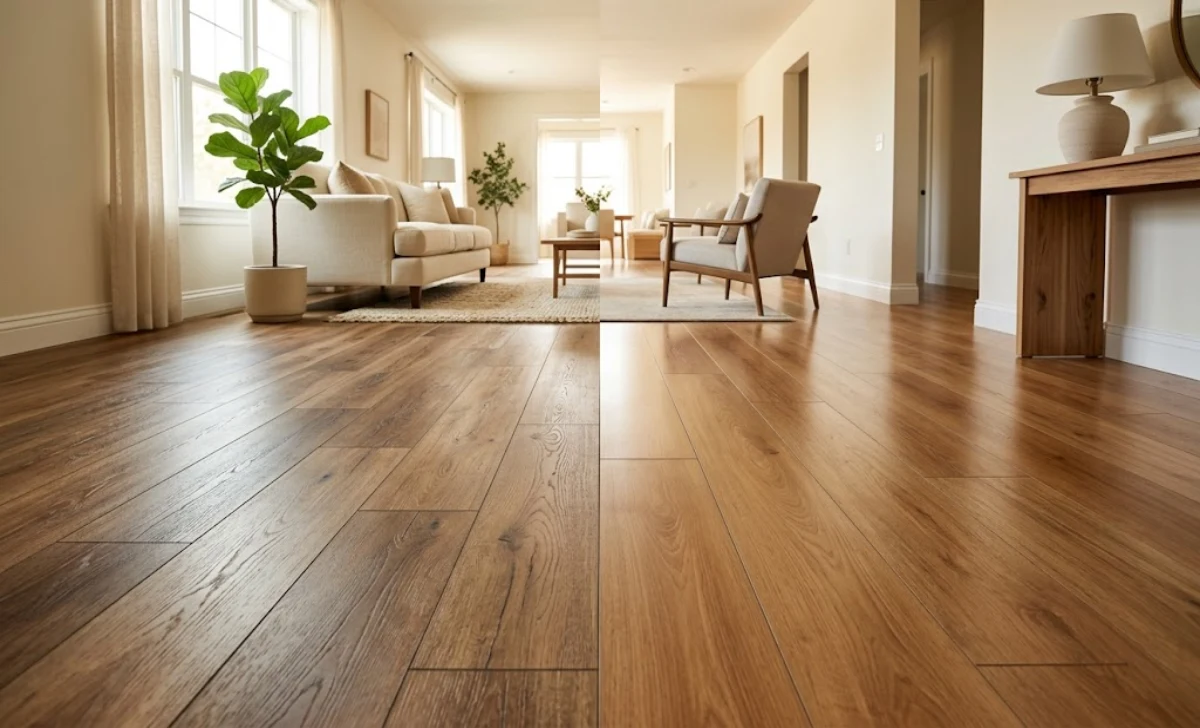
Luxury vinyl plank (LVP) is 100% waterproof, making it better for kitchens, bathrooms, and basements. Laminate is slightly cheaper and warmer underfoot, but its wood-fibre core can swell with moisture. For whole-home use or wet areas, choose LVP. For dry rooms on a budget, laminate is a solid option.
You’ve narrowed it down to two choices: luxury vinyl plank or laminate. Both look great in the showroom. Both are cheaper than hardwood. Both claim to be tough, easy to install, and low-maintenance.
So why does choosing between them feel so hard?
Because the differences that actually matter — how they hold up to water, pets, kids, and time — are buried in marketing language that makes both options sound perfect.
This guide cuts through that. By the time you finish reading, you’ll know exactly which flooring fits your home, your budget, and your lifestyle.
What Is Luxury Vinyl Plank (LVP) Flooring?
Luxury vinyl plank is a multi-layer synthetic flooring product. Despite the name, it contains no wood. Instead, it’s built from several bonded layers: a tough wear layer on top, a printed design layer beneath it, a rigid or flexible core in the middle, and sometimes a pre-attached underlayment at the bottom.
The wear layer is what gives LVP its reputation for durability. It’s measured in mils (thousandths of an inch), and thicker wear layers — typically 12 mil or higher — hold up much better in high-traffic areas.
Most LVP products on the market today use either a WPC (wood-plastic composite) or SPC (stone-plastic composite) core. SPC is denser and more rigid, which makes it more stable in rooms with temperature swings. WPC cores are slightly softer underfoot, which some people prefer for comfort.
LVP is 100% waterproof. Not water-resistant — actually waterproof. That single fact drives most of the buying decisions that favour it over laminate.
What Is Laminate Flooring?
Laminate flooring is made primarily from compressed wood fibre, usually high-density fiberboard (HDF). On top of that core sits a photographic layer that mimics the look of wood, stone, or tile. A clear protective coating finishes the surface.
That wood-fibre core is the core strength and weakness of the laminate. It produces a more authentic underfoot feel — slightly warmer and softer than vinyl — and it tends to be more dimensionally stable in consistently climate-controlled homes. But that same core absorbs moisture. Leave standing water on the laminate long enough, and the boards swell, warp, and separate at the seams.
Modern laminate has improved significantly. Some products carry water-resistant ratings, and a few brands claim limited waterproofing for the surface layer. But the core remains vulnerable once water gets underneath — through seams, edges, or subfloor gaps.
Laminate is typically thicker than LVP, which contributes to a slightly more solid sound when you walk on it.
Side-by-Side Comparison
| Feature | Luxury Vinyl Plank (LVP) | Laminate |
|---|---|---|
| Waterproof | Yes (100%) | No (surface-resistant at best) |
| Durability | Excellent — dent-resistant | Good — can chip at edges |
| Lifespan | 15–25 years | 15–25 years |
| Cost per sq ft | $2–$7 (materials) | $1–$5 (materials) |
| Installation | Click-lock, floating, or glue-down | Click-lock, floating |
| Comfort underfoot | Firm; softer with WPC core | Warmer, slightly more cushioned |
| Scratch resistance | High (wear layer dependent) | High (AC rating dependent) |
| Noise | Can sound hollow; padding helps | Slightly quieter with underlayment |
| Resale value impact | Moderate | Moderate |
| Eco impact | Synthetic; PVC-based | Partially wood fibre; some recycled content |
| Best rooms | Bathrooms, kitchens, basements | Bedrooms, living rooms, offices |
| DIY-friendly | Yes | Yes |
Key Differences Explained
Water Resistance
This is the biggest practical difference between the two.
LVP is made from plastic. Water cannot penetrate it — not the surface, not the core. You can mop it, leave a wet towel on it for hours, or install it in a bathroom with tile shower runoff nearby, and it will be fine.
Laminate’s HDF core will swell if water gets into the seams or underneath. Even “waterproof laminate” products protect the surface coating, but cannot fully seal the plank edges or subfloor gap. In rooms with regular moisture exposure — bathrooms, laundry rooms, basements — laminate carries real risk.
Winner: LVP, clearly.
Durability and Scratch Resistance
Both floors are tough, but they fail in different ways.
LVP resists dents well because the plastic core compresses rather than cracks. Scratches depend entirely on the wear layer thickness. A 6-mil wear layer is fine for low-traffic areas; anything 12 mil and above handles heavy use.
Laminate resists surface scratches well — look for an AC3 or AC4 rating for residential use. But the edges and corners of laminate planks are more prone to chipping if heavy furniture is dragged across them or items are dropped from a height.
Winner: Tie for most households. LVP edges ahead in homes with dogs.
Cost Comparison
Laminate is generally cheaper on the material side, often running $1–$5 per square foot versus $2–$7 for LVP. But material cost is only part of the picture.
Installation costs are similar for both — both use click-lock systems that work as floating floors without adhesive. For a 500-square-foot room, the total installed cost (materials plus labour) typically falls in the range of $1,500–$4,000 for laminate and $2,000–$5,500 for LVP, depending on quality tier and your region.
Long-term cost is where LVP can actually save money. Because it’s waterproof, it doesn’t need replacing after a bathroom leak or flooding event. Laminate water damage often means full replacement.
Winner: Laminate for upfront cost. LVP for total cost of ownership.
Installation
Both products use similar click-lock floating floor systems, meaning most homeowners with basic DIY skills can install either without professional help.
A few practical differences:
- LVP is more forgiving of imperfect subfloors because of its flexibility, especially WPC core products
- Laminate requires a flatter subfloor — typically no more than 3/16-inch variation over 10 feet
- LVP can sometimes go directly over existing flooring; laminate generally cannot
- Both need an expansion gap around the perimeter, and both should acclimate to room temperature before installation
Winner: LVP, slightly, for flexibility over imperfect subfloors.
Maintenance and Cleaning
Both floors are easy to maintain. Sweep or vacuum regularly, mop with a damp (not wet) cloth for laminate, and you’re covered.
With LVP, you can use a wetter mop because there’s no risk of water damage. That makes cleaning spills and high-traffic areas faster and more thorough.
Neither floor needs refinishing, waxing, or special treatments.
Winner: LVP for cleaning ease. Effectively tied for day-to-day maintenance.
Room-by-Room Recommendations
Kitchen
Choose LVP. Kitchens get splashes, drips, and the occasional appliance leak. LVP handles all of that without worry. Laminate will work if you clean spills immediately, but one slow dishwasher leak can destroy an entire floor.
Bathrooms
Choose LVP. This is non-negotiable. The moisture environment in a bathroom — steam, condensation, wet feet, possible flooding — is exactly what laminate cannot tolerate. LVP is the only sensible choice here.
Basement
Choose LVP. Basements are prone to humidity and occasional moisture intrusion. LVP’s waterproof core means a damp basement or minor flooding won’t automatically destroy the floor.
Bedrooms
Either works well. Bedrooms see minimal moisture and lower foot traffic. If budget is a priority, laminate’s lower price point makes it attractive here. If you want consistency throughout the home, matching LVP from the main areas works fine.
Living Rooms and Family Rooms
Slight edge to LVP for pet owners and families with young kids. For a drier, lower-traffic household, laminate is a perfectly fine and cost-effective option.
Home Office
Laminate is a solid pick. Climate-controlled, dry, low-traffic — this is laminate’s sweet spot. The slightly warmer feel underfoot is a bonus if you’re barefoot at your desk.
Noise and Comfort Underfoot
Both LVP and laminate can produce a hollow or clicky sound when walked on — this is the main complaint in online reviews for both products. Adding quality underlayment helps significantly.
Laminate has a slight edge in terms of warmth underfoot, since the wood-fibre core retains a bit more heat than solid plastic. SPC-core LVP, in particular, can feel firmer and cooler than laminate.
If comfort is a priority, WPC-core LVP with attached underlayment is your best bet for a floor that’s both waterproof and comfortable to walk on.
Environmental Considerations
This is worth thinking through, especially if sustainability matters to you.
Laminate contains real wood fibre, often from managed forests, and some products carry CARB2 or GREENGUARD certifications for low emissions. The HDF core is partially a recycled wood product.
LVP is made from PVC (polyvinyl chloride), a petroleum-based plastic. It does not biodegrade. Some manufacturers have improved this by using recycled content in the core and reducing phthalate use. The EPA has flagged PVC production as an environmental concern in the past.
Neither floor is perfect from an environmental standpoint. If eco impact matters most, look for GREENGUARD Gold–certified products in either category, and check manufacturer sourcing policies directly.
Winner: Laminate, narrowly, for lower environmental footprint.
Pros and Cons at a Glance
Luxury Vinyl Plank (LVP)
Pros:
- 100% waterproof
- Works in bathrooms, kitchens, and basements
- Resists dents and heavy foot traffic
- Flexible installation over minor subfloor imperfections
- Easy to clean thoroughly
Cons:
- Higher upfront cost than laminate
- Feels less warm underfoot (especially SPC core)
- PVC-based — less eco-friendly
- Cannot be refinished or sanded
Laminate Flooring
Pros:
- Lower material cost
- Warmer, more natural feel underfoot
- Higher-end products closely mimic hardwood
- Partially wood-based (more sustainable production)
- Slight edge in acoustic feel
Cons:
- Not waterproof — core swells with moisture
- Risky in bathrooms, kitchens, and basements
- Edge chipping under heavy impact
- Cannot be refinished
Which One Should You Choose?
Here’s the honest short answer:
Choose LVP if: you have pets, kids, or plan to install in any room that sees moisture. The waterproof core gives you peace of mind that laminate simply cannot match.
Choose laminate if: you’re flooring dry, climate-controlled rooms — bedrooms, offices, living rooms in low-moisture homes — and want to keep costs down without sacrificing appearance.
Choose LVP for the whole house if: you want one consistent floor from kitchen to bedroom without worrying about which rooms can handle what. The slight premium is worth the simplicity.
One more thing worth saying: both floors look great. Modern printing technology has made it genuinely difficult to distinguish high-quality LVP or laminate from real hardwood in photos and from a standing position. Choose based on performance needs, not aesthetics alone.
Final Verdict
If you’re choosing flooring for the whole house and want one product that works everywhere, LVP is the stronger choice. It handles every room, tolerates every kind of mess, and protects you from the most common flooring disaster — water damage.
If you’re flooring a single room or a dry area of your home and budget is a real constraint, laminate is a capable, cost-effective option — as long as you keep it away from moisture.
The best floor is the one that fits how you actually live. Both of these products can look beautiful for years. The difference is in how much forgiveness you get when life happens.
FAQs
Is luxury vinyl plank better than laminate?
For most homes, yes — especially if you have moisture-prone rooms, pets, or young children. LVP’s waterproof core solves the biggest long-term risk with laminate. If you’re flooring only dry rooms on a tight budget, laminate is a fair choice.
Can laminate flooring get wet?
Surface moisture is fine if cleaned quickly. Standing water, flooding, or persistent humidity will damage the HDF core over time, causing swelling, buckling, and seam separation. Laminate should not be installed in bathrooms or basements.
How long does LVP last compared to laminate?
Both products have similar rated lifespans — typically 15 to 25 years, depending on quality tier and traffic levels. LVP tends to hold up better in real-world conditions because water damage is the most common reason laminate fails prematurely.
Which flooring is better for dogs?
LVP generally holds up better with dogs. The wear layer resists scratches from nails, the waterproof core handles accidents without damage, and there are no raised edges that can catch and split under heavy paw traffic. Look for LVP with a 12-mil wear layer or higher.
Is LVP or laminate easier to install?
Both use click-lock floating floor systems that are DIY-friendly. LVP has a slight advantage because it’s more forgiving over uneven subfloors, and some products can be installed directly over existing flooring.
Does laminate flooring add value to a home?
Laminate does not typically add resale value the way hardwood does, but it can improve buyer perception in the short term by making a home look updated. The same is true for LVP. Neither is considered a premium upgrade for appraisal purposes.