
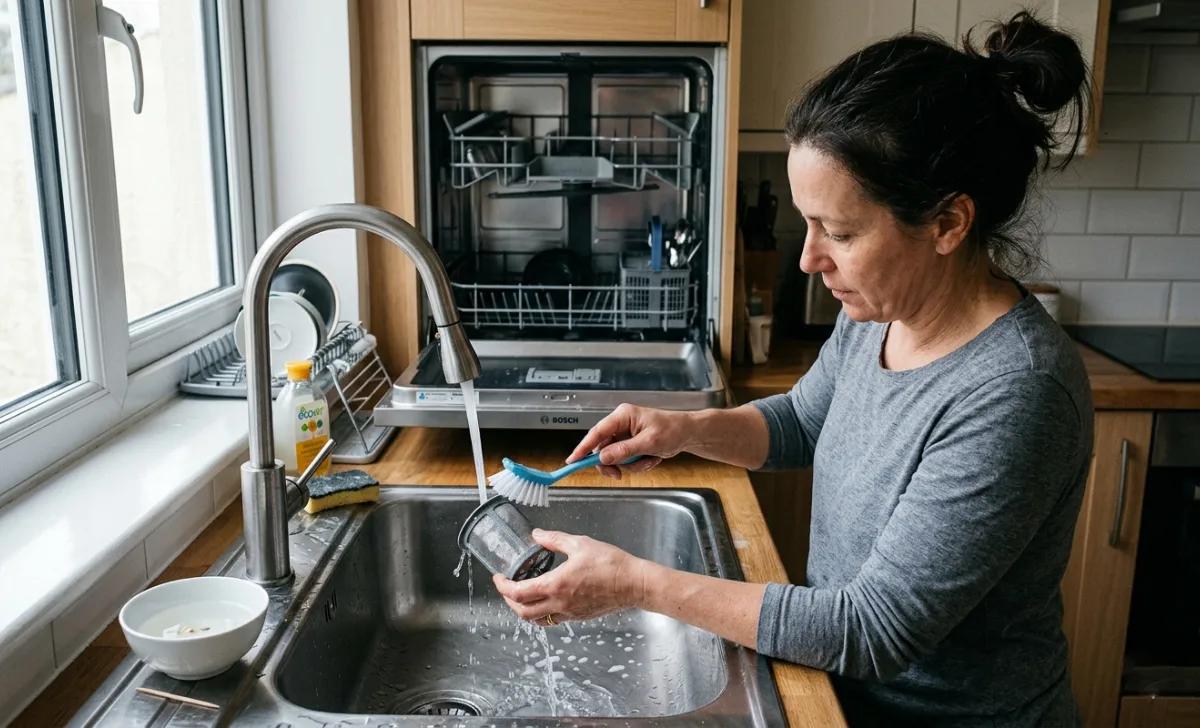
To restore your dishwasher, start by cleaning the filter and spray arms, then inspect the door gasket, check the drain hose, and run a hot vinegar cleaning cycle. Most performance issues come from buildup, clogs, or worn seals — and the large majority can be resolved at home without calling a technician.
A dishwasher that leaves dishes cloudy, fails to drain, or sits silent when you press Start is not necessarily broken beyond repair. In most cases, it is dirty, blocked, or slightly out of alignment. This guide walks through every meaningful step — in the right order — to help you restore your dishwasher to proper working condition.
Start Here — Diagnose Before You Fix
Jumping straight into repairs without identifying the problem wastes time. Begin with a quick symptom check.
| Symptom | Most Likely Cause |
|---|---|
| Water is pooling at the bottom | Clogged filter or drain hose |
| Dishes coming out dirty or spotty | Blocked spray arms, wrong detergent, low water temp |
| Dishwasher is leaking from the door | Worn or dirty door gasket |
| Won’t start | Door latch fault, tripped circuit breaker, control lock on |
| Unusual grinding or rattling noise | Debris in the pump, blocked spray arm rotation |
| White chalky residue on dishes | Hard water mineral buildup |
| Bad odour | Dirty filter, mould on door seal |
A Simple Diagnostic Checklist
Before opening anything up, run through this:
- Is there standing water after a cycle? → Start with Step 4 (Drainage)
- Are dishes coming out dirty but the machine runs fine? → Start with Step 1 and Step 6
- Is the door leaking? → Go to Step 3
- Does the machine not respond at all? → Check the circuit breaker, door latch, and control lock setting first
Step 1 — Clean the Filter (Most Overlooked Fix)
The filter sits at the base of the dishwasher tub, usually beneath the lower spray arm. Its job is to catch food particles so they don’t recirculate onto clean dishes. When it clogs — which happens faster than most people expect — water flow drops, drainage slows, and cleaning performance falls.
How to clean it:
- Remove the bottom rack
- Twist or unclip the filter (check your model’s manual — most turn counter-clockwise)
- Rinse it under warm running water
- Scrub gently with a soft brush to remove grease and debris
- Reinstall and secure it properly
Most manufacturers suggest cleaning the filter monthly. If you notice dishes deteriorating faster, clean it every two weeks.
Step 2 — Restore the Spray Arms
Spray arms distribute water across your dishes under pressure. The small holes along the arms get blocked by food particles, limescale, and mineral deposits — especially in hard water areas.
How to clear them:
- Remove the lower and upper spray arms (most simply pull off or unscrew)
- Hold them under running water and identify blocked holes
- Use a toothpick or thin needle to clear each hole
- Soak in warm white vinegar for 15–20 minutes if mineral scale is visible
- Rinse thoroughly and reattach
Also check that the spray arms can rotate freely when installed. Large plates, bowls, or pot lids positioned incorrectly on the bottom rack can physically block rotation, which causes uneven cleaning and sometimes noise.
Step 3 — Check and Clean the Door Gasket
The door gasket is the rubber or silicone seal that runs around the inside of the dishwasher door frame. It creates a watertight barrier during each cycle. Over time, grease, food residue, and mold collect along its surface — and when it degrades further, it causes leaks.
Cleaning the gasket:
- Wipe the entire seal with a damp cloth dipped in warm, soapy water
- Pay close attention to the folds and corners where mold collects
- For stubborn mold, a small amount of white vinegar on a cloth works well
When to Replace vs. When to Clean
If the gasket feels stiff, has visible cracks, or does not spring back when pressed, it needs replacing. A replacement door gasket for most models costs between $15 and $40 and can be fitted at home with no special tools. If it is simply dirty but still pliable, cleaning is enough.
Step 4 — Address Drainage Problems
Standing water at the bottom of the tub after a cycle points to a drainage fault. Work through the causes in order of likelihood.
Check the drain filter first — this is the most common cause and the easiest to fix (covered in Step 1).
Drain Hose, Air Gap, and Garbage Disposal Connection
- Drain hose: Inspect it for kinks or partial blockages. The hose should form a high loop under the sink (called a high loop installation) to prevent backflow. If it lies flat or sags, water can back up.
- Air gap: Some kitchens have a small chrome fitting near the faucet. If clogged, it blocks drainage. Remove the cap and clean out any debris.
- Garbage disposal: If your dishwasher drains through the disposal, run the disposal for 10–15 seconds before starting a wash cycle. If the disposal was recently installed or replaced, confirm the knockout plug inside the inlet was removed — a missed step that prevents drainage entirely.
Drain Pump — When It Is the Actual Cause
If the above checks pass and water still pools, the drain pump motor may be faulty. Testing it requires a multimeter and some comfort with appliance internals. At this point, calling a certified technician is the practical path for most homeowners.
Step 5 — Run a Deep Cleaning Cycle
Once the physical components are clean, a cleaning cycle removes residual grease, odours, and mineral deposits from the interior walls, hoses, and heating element.
Vinegar Method
- Place a dishwasher-safe bowl or cup filled with two cups of white vinegar upright on the top rack
- Run a full hot cycle with no dishes and no detergent
- The vinegar dissolves mineral scale and neutralises odours
When to Use CLR Instead
If your dishwasher has a stainless steel interior — which most modern units do — vinegar used repeatedly can damage the finish over time. In that case, a calcium/lime/rust remover (CLR) is a safer choice. It is also more effective for heavy mineral buildup in hard water households. Do not use bleach in a dishwasher with a stainless interior, as it causes corrosion.
Step 6 — Fix Poor Cleaning Performance
If the machine runs normally but dishes come out cloudy, spotty, greasy, or with food still on them, the problem is usually one of three things.
Water Temperature and the 120°F Rule
Dishwasher detergent — particularly enzyme-based powder — needs hot water to activate. The water entering your machine should be at least 120°F (49°C). You can check this with a simple kitchen thermometer at the tap.
A useful trick: Before starting your dishwasher, run the kitchen faucet on hot until the water feels hot to the touch — usually 30–60 seconds. This clears the cold water sitting in the supply line and ensures your machine fills with genuinely hot water from the first moment. It makes a real difference, and very few guides mention it.
Detergent Type: Powder vs. Gel vs. Pods
This matters more than most people realise.
| Type | Performance | Notes |
|---|---|---|
| Powder | Best overall | Contains bleach + enzymes; handles stains and food residue well |
| Pods / Tablets | Very good | Convenient; pre-measured; quality varies by brand |
| Gel | Weakest | No bleach; lacks enzymes; leaves greasy film more often |
If your dishes have a greasy feel after washing, switching from gel to powder or quality pods is often enough to solve it.
Loading Correctly and Enzyme Activation Explained
A common mistake is pre-rinsing dishes too thoroughly before loading them. Modern dishwasher detergents use enzymes that need food residue to activate properly. Scrape off large food chunks but leave light residue — the detergent works with it, not against it.
Beyond that: place larger items on the bottom rack with the soiled face toward the spray arm, load cups and glasses upside down, and never block spray arm rotation. Knives go point-down; everything else goes soiled-end up.
Step 7 — Restore Dishwasher Racks
Rack tines can rust and chip over time, especially where the vinyl coating wears through. Exposed metal does two things you want to avoid: it transfers rust marks to dishes and can scratch glassware.
Fix it with a vinyl rack repair kit — available from most appliance parts suppliers for around $10–$15. Clean the affected area, apply the liquid vinyl coating to exposed tines, and allow 24 hours to dry before using the rack again. This extends rack life significantly and is far cheaper than rack replacement ($80–$200+).
If the entire rack is heavily rusted or the coating is peeling widely, replacement is the better call.
Lesser-Known Fix — Check If Your Dishwasher Is Level
An unlevel dishwasher is a surprisingly common cause of both drainage and spray performance problems, and almost no mainstream guide covers it.
Dishwashers are gravity-dependent. The interior slopes slightly toward the drain — if the unit is tilted in the wrong direction, water does not flow to the drain as intended. Spray arms also distribute water less evenly.
To check and correct it:
- Place a small bubble level on the bottom rack floor
- Adjust the front feet by turning them clockwise (to retract) or counter-clockwise (to extend) until the unit reads level
- The rear feet on most models self-adjust when the front ones are set correctly
Dishwasher Maintenance Schedule
| Task | Frequency |
|---|---|
| Clean the filter | Monthly (or every 2 weeks with heavy use) |
| Wipe door gasket and frame | Monthly |
| Clean spray arm holes | Every 2–3 months |
| Run a cleaning cycle (vinegar or CLR) | Monthly |
| Inspect drain hose for kinks | Every 6 months |
| Check rack coating for chips | Every 6 months |
| Check leveling | Annually or after any move/reinstall |
| Inspect float switch for debris | Annually |
When to Stop Repairing and Replace Instead
As of 2026, the general guidance from appliance technicians is the 50% rule: if a repair will cost more than 50% of the price of a comparable new unit, replacement is the better financial decision.
Beyond cost, consider replacing your dishwasher if:
- It is older than 10 years and experiencing repeated faults
- There is internal tub rust or cracking (water damage risk)
- The control board has failed — these repairs are expensive and often exceed the appliance’s remaining value
- Modern units in the same price bracket offer significantly better energy and water efficiency, which lowers running costs year over year
If none of these apply, a well-maintained dishwasher running 8–12 years can often be brought back to reliable performance through the steps above.
FAQs
How often should I clean my dishwasher filter?
Clean it at least once a month. If you run your dishwasher daily or wash heavily soiled items regularly, clean it every two weeks. A dirty filter is the single most common cause of poor cleaning results and slow drainage.
Why does my dishwasher leave white residue on dishes?
White residue is almost always caused by hard water mineral deposits — calcium and magnesium left behind as water evaporates. Running a monthly vinegar or CLR cleaning cycle, using a rinse aid in every wash, and switching to a hard water-specific detergent powder all help reduce it significantly.
Is it worth repairing a dishwasher that is 10 years old?
It depends on the fault. Cleaning and gasket replacements are worth doing at any age. If the pump, motor, or control board has failed on a unit over 10 years old, the repair cost usually approaches or exceeds what a reliable new dishwasher costs — in which case replacement makes more practical sense.